
‘Do You Let Them Win?’ – Being the Gamer of a Children’s Hospital
- Written by:
- Published: 21st May 2026
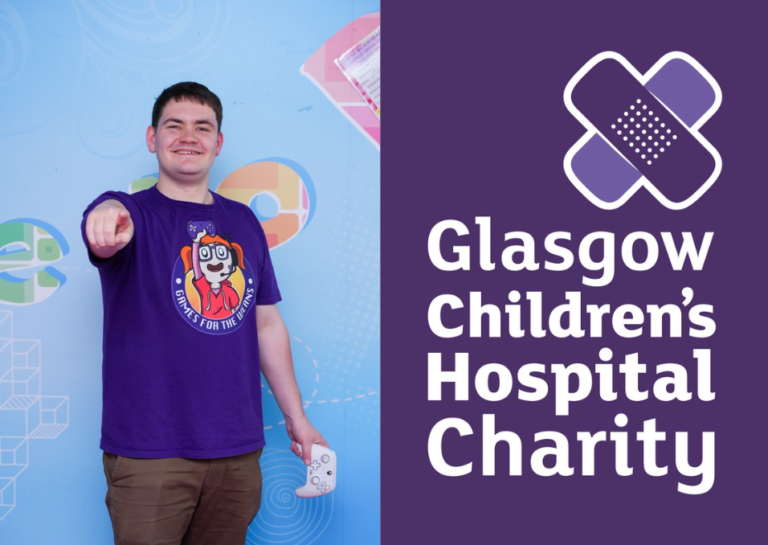
Steven Mair gives us an insight into his role as a gamer at the Glasgow Children’s Hospital Charity.
At the heart of Getting it right for every child (GIRFEC) is the belief that children and young people should feel safe, respected, included, and supported to thrive, even during the most challenging times in their lives. This blog from Steven Mair at Glasgow Children’s Hospital Charity highlights how creative, relationship-based support can make a meaningful difference to wellbeing within healthcare settings.
Through gaming, connection, and shared experiences, Steven’s role helps reduce isolation and gives children and young people opportunities for choice, confidence, achievement, and joy while in hospital. It is a powerful example of how listening to young people’s interests and meeting them where they are can support emotional wellbeing, strengthen relationships, and uphold the values and principles of GIRFEC.
I’m Steven Mair, and for the last two years, I’ve had quite an interesting job. I’m the lead gamer at a children’s hospital. Specifically, that is Glasgow Children’s Hospital Charity, located at the Royal Hospital for Children in Govan.
In the US and elsewhere, ‘Game Techs’ are a common role in paediatric healthcare facilities. As children get more and more into video games, this is someone who makes sure it’s never the job of a doctor or nurse to fix a controller or Xbox console. That, however, is only a small part of the job. I’m also on hand for any patient that would like to game with a second player, a gaming buddy of sorts while they are in hospital. We’re using gaming to fight against loneliness and boredom and use the video games children and young people love in a positive way. I also manage a fantastic team of Gaming Volunteers who give up their time to do the same.
I’ve been doing this role for two years, and throughout that time I’m so grateful that our programme has been graciously fully funded by gamers, gaming companies, and the incredible organisation that is Child’s Play. They are based in Seattle, near one of the first hospitals to ever hire a gamer, and they not only fund projects like this but also function as a centralised base of knowledge in the field. When I have a question or need inspiration, I can ask the community of Game Techs and someone from Orlando or Houston may reply back. I also took Child’s Play’s Paediatric Gaming and Technology Certification, giving me more knowledge in so many vital areas.
One day, I asked one of my mentors in the community a question. I am always asked, “Do you let them win?” in relation to the children I support. It’s not always something I have to think about – if I’m gaming with a 15-year-old there’s a good chance they’ll wipe the floor with me. But those younger kids, the ones whose birth years are increasingly starting to begin with the words ‘twenty-twenty’, yes, it’s something I have to consider. In those instances, I’ll find out a way we can play cooperatively, where I can teach my patient some of the controls and work together as a team.
My mentor said to me to set up every interaction where that young person is winning no matter what happens on the screen. And that’s what I try to do every time we pick up a controller together: make sure they are winning.
To learn more and support our work in the children’s hospital, visit our website or search ‘Games for the Weans’.
End of page.
You may also like:
When we listen to lived experience, we create better resources, challenge assumptions and help create safer communities for everyone.
Continue readingReflections on the Children (Withdrawal from Religious Education) Bill
Continue readingWhat does the new National Transitions to Adulthood Strategy for Young Disabled People mean for young people with learning disabilities?
Continue readingTo improve outcomes for children and young people, we must consider how we can build on GIRFEC for the future.
Continue readingLorraine Glass, Director at respectme, reflects on the vital work they do to reduce bullying and improve wellbeing.
Continue readingJamie Spiers reflects on the barriers for children in accessing their rights and calls for robust rights-based training in schools.
Continue readingGiving unique insights into individual's lives, experiences, needs, and sense of character.
Continue reading