
Award winning Arora dementia friendly community project
- Written by: Paula Brown — Dementia Friendly Community at An Lanntair Arts Centre in Stornoway — Project Co-ordinator for Arora
- Published: 12th June 2017
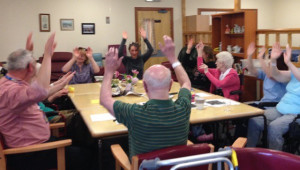
Kicking off a new week with a guest blog from Paula at the Arora Project. Lets see what Paula has to tell us....
I’m Paula Brown, Project Co-ordinator for Arora, the Dementia Friendly Community at An Lanntair Arts Centre in Stornoway.
We have been funded for three years by Life Changes Trust to investigate bilingualism in dementia through arts based engagement and we have been fortunate enough to have other pots of funds for specific work from other funders such as Alzheimer Scotland, the NHS, Wm Grant Foundation and DEEP.
An Lanntair has a wealth of art experiences to offer the entire community and I am extremely fortunate that my job is to share that with people who have dementia and those in their circle of care. This could mean hosting a dinner where people living with dementia share experiences and thoughts with the An Lanntair team to feed back about programming and requirements for the building (lighting and signage etc), it could mean adapting an exhibition or putting on special dementia friendly performances or screenings of films. It might mean screening films in care centres, or offering new ways of watching local archive film on a tablet computer which is shared on the mobile library bus.
The Artists that we work with are selected for their empathic and collaborative ways of working with people and this way, we have created some incredible works of art together, from very personal quilts to an immense piece of public image art in a care centre and hospital.
Some of our work is about including and involving very isolated people to participate in projects. For example, at a local hospital, the community pulled together to renovate a ward garden and we were able to work with people living with dementia on the ward to select colours for paint and to select seeds for planting and to do some planting, despite the conditions of advanced dementia. Tasting, picking up and eating berries, pointing, facial expressions and smelling were all ways in which people on the ward were able to contribute. Isolated people at home are able to book our memory boxes and archive film tablets as easily as they do a library book.
Collaboration is at the heart of everything we do. Collaboration with a person on an individual level, collaboration with families, carers, paid carers, collaboration with Museums, Libraries, Charities, NHS teams, Universities and Artists, this is how we achieve our best work. Our NHS Hospital ceilidhs are a great example of this collaboration between the NHS, Alzheimer Scotland and ourselves.
Supporting carers is vital. We often meet carers through working at the Day Centres, through meeting them at community sessions, through carers groups and we offer crafting and arts opportunities and the chance to work with an Artist. We often see carers coming along to sessions and cinema screenings. We provide carers kits to supply personal time activity and meet with them once a month for dinner. We are also there for carers when through a difficult personal decision or through a decision made by others, the caring role changes and the cared for person moves to a care setting. Because we work closely with people in care settings too, I was reminded this week how important the whole community approach is, when a lady thanked me and said she was able to feel more positive about the move when she knows we will continue to offer sessions and visits just as we did within the community and in hospital.
We value the knowledge and experience of the people we work with – our Woven Communities project with University of St Andrews brought forward some amazing insights for Museums to share with the community and for basketmakers and academics to learn about how techniques were employed, given eagerly by people living with dementia either through demonstrating with hand memory or through being able to tell us.
One key point that we have discovered through studying bilingualism is that language is never just one or two – we all communicate in so many ways and that artistic communication has proven to be particularly valuable for people with dementia losing their ability to communicate through words. Dance, imagery, collage, planting, even making and preparing food has offered methods of self expression that we have valued together immensely.
This project aims to leave a legacy of a record of ways of reaching a person on an emotional and personal level that supports them to communicate and express that emotion and person and ways to maintain community and cultural connections.
Please take a look at our blog on http://dfclanntair.wordpress.com (This link will take you away from our website) or get in touch at paula@lanntair.com for more information.
End of page.
You may also like:
Chloe Craig reflects on how we have helped connect Scotland’s lived experience voice to conversations happening beyond our borders.
Continue readingDr Irene Oldfather reflects on two decades of growth, collaboration, and person centred impact across Scotland and beyond.
Continue readingDisabled people are some of those who suffer most in crises but are ignored in planning. Our 6-step model builds justice throughout.
Continue readingMaisie Peebles shares her experience working with Aberdeenshire Public Health Team on a ‘digital conversations’ project.
Continue readingSara Redmond, ALLIANCE Chief Officer, on why the Scottish Government and parties must seize the opportunity for change.
Continue readingDirector of the Links programme, Roseann, discusses why we need to focus on person centred care, and why the programme is central to this.
Continue readingReflections on the ALLIANCE Integration in Action: Inclusive Leadership event.
Continue readingWhat does The Scottish Report tell us about how we're supporting people with inflammatory mediated autoimmune conditions (IMIDs)?
Continue readingAvril McLean from Action from ME shares new resources designed to support professionals understand the impact of ME on people's lives.
Continue readingMandy Wright from Home Energy Scotland shares how partnerships positively impact their work.
Continue readingToo many young people are falling through the mental health support gap. How do we fix the "Missing Middle"?
Continue readingJoe McCready from Carers UK shares how important their annual survey is, and why it is invaluable for unpaid carers to have their say.
Continue readingColette reflects on the last 12 years of the Community Links Worker programme, as well as her own experience of being a CLW.
Continue readingWith the current World Cup, gambling presents an even higher risk. How can we prevent young people from getting tangled in this web?
Continue readingDr Anthony McMahon reflects on the importance of the Community Links Worker within his GP surgery - and why it makes all the difference.
Continue readingAs part of our 20 year anniversary, the Integration Team highlight the importance of our Connected Communities series.
Continue readingTo mark ‘What matters to you?’ Day, The ALLIANCE's Barbara Flynn considers the impact of Tommy Whitelaw’s talks for nurses and midwives.
Continue readingThe ALLIANCE’s Humans of Scotland project works to challenge stigma.
Continue readingIn her latest TFN column, our Chief Officer Sara Redmond reflects on post election feelings and Scotland’s future.
Continue readingALLIANCE Chief Officer, Sara Redmond, reflects on our Annual Conference 2026 and how we're turning hope into action.
Continue readingALLIANCE member, Catherine, shares the importance of initiatives like 'What Matters To You?' Day in promoting person centred care.
Continue readingLearn about how the ALLIANCE has championed joined-up, person centred care.
Continue readingDementia Action Week highlighted some great resources and support for people living with dementia and their family, friends, and carers.
Continue readingSteven Mair gives us an insight into his role as a gamer at the Glasgow Children’s Hospital Charity.
Continue readingSince 2009, ALISS has helped people find local health and wellbeing support. Any group, big or small, can add their information.
Continue reading