
What we took away from the Scotland Conference on Integrated Care (SCIC) 2026
- Written by:
- Published: 10th November 2026
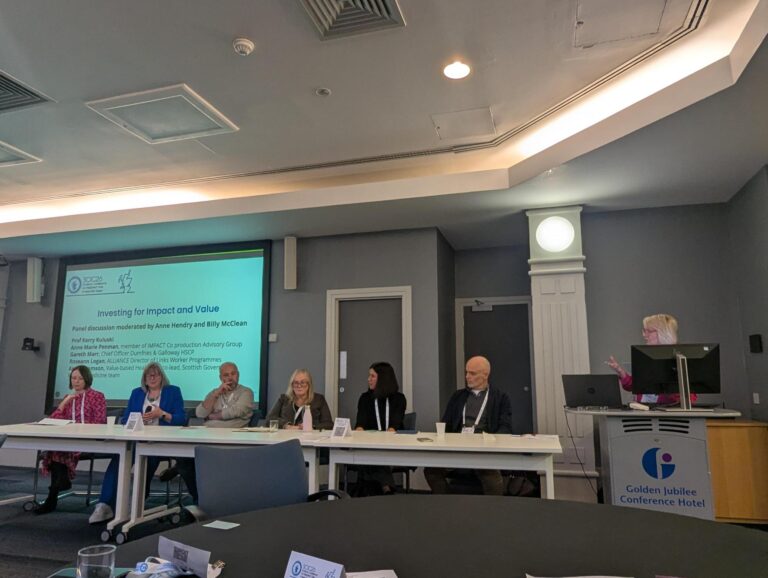
The ALLIANCE Integration team reflect on the Scotland Conference on Integrated Care (SCIC) 2026.
On Tuesday 27 October 2026, colleagues came together in Glasgow and online for the Scotland Conference on Integrated Care (SCIC), hosted by IFIC Scotland and partners. Contributors from health, social care, housing, the third sector and lived experience explored how innovation can become better care and support. The programme covered preventative and place-based care, digital innovation, collaborative workforce solutions, embedding lived experience in learning and improvement, and investing for value and outcomes. Workshops and plenaries offered local, national and international perspectives. One message ran through all of them: integration lives in the ‘space in between’, in the connections and relationships between people, services and sectors. Systems work best when they start from what matters to people rather than what matters to the system. The integration team reflects on what they took from the day.
Ali: What mattered most…
For me, it was hearing about Whole Family Support through General Practice. It’s a Scottish Government funded programme built around a new primary care role, the Family Wellbeing Worker. Modelled on the Community Link Worker, the role gives families holistic, non-medical support with things like housing, food insecurity and caring responsibilities, which clinicians aren’t set up to address. There are six workers in Glasgow’s Deep End practices. The pilot has run for two years and is now being evaluated.
What stood out for me is how simple the principles are. There’s no set definition of ‘family’ and no time limit on support, and any primary care colleague can refer. Much of the support happens in families’ own homes. A parent of two children with additional support needs said that the approach meant she ‘didn’t feel like I was a checklist, I was actually seen as a person’. To me, that reflected the day’s wider themes on relational, needs-led support delivered in the community, and in this case, with the family as the focus. The project is also becoming more connected with other services, such as Glasgow Life, which can offer support through libraries and swim passes. I hope that the evaluation can capture the relational outcomes that are more difficult to measure and don’t always show up in standard measures. This is a fantastic example of what community-led, integrated primary care can look like.
Rachel: My biggest take away…
Services need to work together around what matters to the person, and involve people in designing those services, rather than expecting people to fit around the way our systems are organised.
I joined a workshop led by Socialudo, a social enterprise using games and serious play to turn research into positive real world change. The workshop took us through Pathways Paradox, a serious game co produced with Social Bite, about navigating housing, benefits, employment and support services for people experiencing homelessness. It is designed to simulate real world challenges faced by individuals and aims to help players experience the barriers and reflect on how we should tackle them.
What mattered most to me was the reminder that we need to look at housing and employment from the perspective of the person trying to navigate the systems around them, not just from the perspective of the organisations providing services.
Pathway Paradox offered a glimpse of how frustrating that experience can be. Things that services might treat as separate issues are deeply connected in someone’s life: needing a home to secure a job and needing a job to secure a home. When you are the person trying to move forward, this can present a series of barriers.
For me, it is important to look at what is making this support difficult to access, and what needs to change. That means recognising people’s strengths, aspirations and circumstances, rather than defining them by the challenges they face. This game can help us question our assumptions.”
Charlotte: The thing that gives me hope is…
Our best solutions are simple and build on existing strengths. It is easy to confuse ‘innovation’ with ‘invention’, particularly in the tech-enabled care space, but innovation is really about taking what we already have and finding practical ways to make it work better. I think that comes down to perspective – are we looking at the problem from the point of view of the system, or the person needing support? – and approach – are we making assumptions about what will work for people, or are people able to design what will work for them?
At the end of the day, that is what person centred care is all about. The Digital Lifelines project, led by the Digital Health and Care Innovation Centre, really exemplifies this principle. Digital Lifelines gets devices to people at risk of substance related harms so they can stay connected with their circles of care, from their friends and family, to peer networks, and wider healthcare services. Co-production of apps is another strand of the project, by working with people to develop digital tools that make it easier for them to access the information they want and need.
The success of the programme underscores that people don’t need (or want) grand interventions, we need tools that make life easier. That might be a mobile phone that lets you check in on family and speak to a support worker, or a laptop that makes it easier to stay in education because you can type your essays and attend online tutorials.
While there was much to take away, one message was clear: ‘Digital is not the golden ticket. It is an enabler’, of connection, confidence, and growth. Contrary to a popular adage, innovation is not about disruption but about continuity and improvement over time, not overnight.
Want to catch up on the conference? Speaker presentations and recordings of the plenary sessions are available here.
End of page.
You may also like:
A new pilot project will see a Community Links Worker to be placed in an East End Glasgow high school.
Continue readingMarianne Tyler, Senior Development Officer for our Children and Young People Programme, reflects on 20 years of the ALLIANCE and GIRFEC.
Continue readingA child cannot truly feel safe in a school or community if they do not feel that they belong.
Continue readingFor 20 years, The ALLIANCE has listened to member voices to help protect and improve Scotland's care services.
Continue readingWith the ALISS Customisable Map Tool, organisations can share info about community resources in ways that work for the people they support.
Continue readingIrene Mackintosh, CEO at Mhor Collective shares highlights and hopes for rights in a digital age.
Continue readingIn her latest TFN column, our Chief Officer Sara Redmond reflects on the proposal to collapse Scotland's 14 regional health boards into two.
Continue readingWhen we listen to lived experience, we create better resources, challenge assumptions and help create safer communities for everyone.
Continue readingGozie reflects on supporting citizen engagement, digital inclusion and hopes for the future.
Continue readingDCP member and Project Co-ordinator Esther Misajel shares Pachedu's journey towards digital inclusion.
Continue readingChris Mackie, Director of Digital, reflects on what ALISS has achieved so far this year and shares what is still to come.
Continue readingAt the ALLIANCE and beyond, true and meaningful policy reform means turning people's experiences into lasting action on the ground.
Continue readingGLP-1s can transform health but without adequate wraparound support, weight loss may come at the cost of nutrition, muscle and wellbeing.
Continue readingSheila Duffy, Chief Executive of ASH Scotland, is appealing for support for proposals to restrict tobacco, vapes and nicotine products.
Continue readingBilly McClean reflects on why SCIC26 offers a vital opportunity to learn together, share what works, and shape the future of integrated care
Continue readingTo mark the ALLIANCE's 20 year anniversary Paul Okroj reflects on the importance of supported self management.
Continue readingTo mark Scottish Learning Disability Week (7 - 13 September), Bruce Adamson reflects on this year's call to action.
Continue readingIn her latest TFN column, our Chief Officer Sara Redmond reflects on the current state of social care in Scotland.
Continue readingKicking off September for the ALLIANCE's 20 year anniversary, Grace reflects on the Self Management Programme
Continue readingSara Redmond, ALLIANCE Chief Officer, on the priorities for 2026's Programme for Government.
Continue readingSandra Auld reflects on the ALLIANCE's people focused impact, collaboration, lived experience, campaigns and lasting change in Scotland.
Continue readingMark shares his experience with gambling harms, and how this intersected with the launch of the ALLIANCE's ScotRGH programme in 2020.
Continue readingProfessor Anna Glasier celebrates 20 years of the ALLIANCE and it's vital role in shaping the Women's Health Plan for Scotland.
Continue readingSara Redmond, ALLIANCE Chief Officer, on the challenges faced by community-led health organisations in delivering prevention.
Continue readingAnnie shares her experience of youth politics, and how SAFE has helped her make connections and makes sense of the world of politics.
Continue reading