
Seeing through the diagnosis
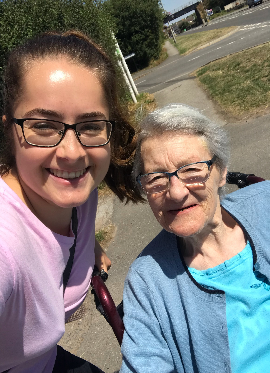
- Written by: Emma Rodrigues — The University of Derby — Second Year Occupational Therapy Student
- Published: 16th October 2018
Emma shares a heartwarming account of her Gran's story and the importance of seeing the person and not the diagnosis.
I really want my Gran’s story to encourage people in any situation (not just dementia) to see the person, not the diagnosis.
Since my Gran passed away, a lot of people said to me ‘no more shame, suffering and loss of dignity.’ I have produced a short video and a piece of writing to express my belief that there doesn’t have to be shame, suffering or loss of dignity with dementia. I really feel that a person with dementia is still the same person and still deserves good quality care, fun and laughter.
‘No more shame’ – If my Gran could see herself living with dementia, I don’t think she would feel shame, I think she would be proud of the way she embraced life to the fullest whilst always keeping her main qualities. Behind the confused, forgetful lady, she was still the same gentle, kind, caring, loving lady she always had been. I think it is really important to look beyond the confusion/frustration of dementia and see the person they truly are.
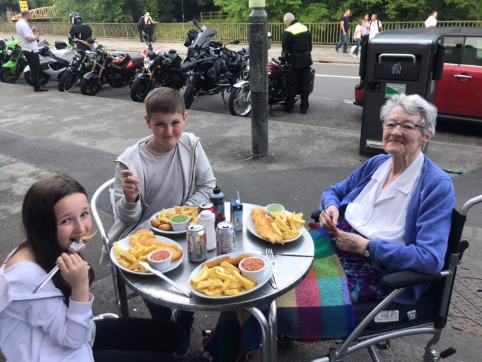
‘No more suffering’ – My Gran certainly never suffered. We made sure she had the best of everything so she could still look her best, eat her favourite foods and live in her beautifully kept bungalow just like she would of done before living with dementia. She also had the best social life ever, we had so much fun together. We would drive far out, take out as much money as I could afford, and have a ball treating ourselves to whatever we wanted – mostly food, drink and souvenirs! We would have fun watching shows, having fish and chips by the sea, going for walks, watching fireworks, doing activities, going for meals and much more!
I think it is really important if possible to still allow a person living with dementia have fun and take part in the activities they would have done before living with dementia (and more in my Grans case!). Some of the things we got up to would never have happened before dementia, if anything, dementia caused her less suffering as she lost her anxieties around going out.
During the time my Gran lived with dementia, a lot of people said ‘she won’t remember anyway.’ A lot of the time we would get home and my Gran would not remember the time we had. To me this didn’t matter, I believe that people benefit from any experience they have and I feel this would still be inside her somewhere – if not, I know she had fun at the time. My Gran also sometimes didn’t recognise that it was me with her, but this didn’t matter to me either. As long as she had fun and felt safe with whoever she thought she was with, that was the most important to me!
‘No more loss of dignity’ – My Gran always had pride in her manner and values. Even if she did get confused around who people were, she would connect with everyone she met and they would love her. There were people that only knew her with dementia and loved her just as much as we did. This shows her loving personality was always present. My gran always held her family close to her heart. At one of her last assessments, she was asked what was most important to her and she said: ‘my family, they are everything.’ This shows that behind dementia, she was still the same person inside.
My Gran proved that a person with dementia still can give love, laughter and happiness to all. She may have acted a little differently, but with support, she still loved and cared like she always had done. Caring for someone with dementia does not have to be traumatic or sad, I created a new best friend and the best memories during my Gran’s time with dementia. It is hard, but if your support is what it takes to let people live as ‘normally’ as possible.. I feel it is totally worth it!
You can watch a short video that Emma put together in memory of her Gran here on her Twitter page (this link will take you away from our website).
End of page.
You may also like:
Dr Anthony McMahon reflects on the importance of the Community Links Worker within his GP surgery - and why it makes all the difference.
Continue readingAs part of our 20 year anniversary, the Integration Team highlight the importance of our Connected Communities series.
Continue readingTo mark ‘What matters to you?’ Day, The ALLIANCE's Barbara Flynn considers the impact of Tommy Whitelaw’s talks for nurses and midwives.
Continue readingThe ALLIANCE’s Humans of Scotland project works to challenge stigma.
Continue readingIn her latest TFN column, our Chief Officer Sara Redmond reflects on post election feelings and Scotland’s future.
Continue readingALLIANCE Chief Officer, Sara Redmond, reflects on our Annual Conference 2026 and how we're turning hope into action.
Continue readingALLIANCE member, Catherine, shares the importance of initiatives like 'What Matters To You?' Day in promoting person centred care.
Continue readingLearn about how the ALLIANCE has championed joined-up, person centred care.
Continue readingDementia Action Week highlighted some great resources and support for people living with dementia and their family, friends, and carers.
Continue readingSteven Mair gives us an insight into his role as a gamer at the Glasgow Children’s Hospital Charity.
Continue readingSince 2009, ALISS has helped people find local health and wellbeing support. Any group, big or small, can add their information.
Continue readingThe new Scottish Government must turn promises into action to improve hospice and palliative care
Continue readingTogether, we can create lasting change for everyone living with Crohn’s or Colitis.
Continue readingFind out more about these digital self management tools and how to get in touch to arrange an information session.
Continue readingOur Chief Officer Sara Redmond addresses recent commentary on the relationship between Government and the Third Sector.
Continue readingCornell explores how we can build an environmental human rights-based culture
Continue readingLouise Coupland, Digital Health and Social Care Programme Manager shares her opinions on the national roll out of MyCare.scot.
Continue readingChris Mackie, Director of Digital, looks back at how ALISS has developed, grown, and innovated over time.
Continue readingCrohn’s and Colitis care in Scotland is at a pivotal moment. Urgent action is needed to tackle delays and poor access to vital services
Continue readingThe ALLIANCE’s Lewis Shaw reflects on the importance of rehabilitation support.
Continue readingIsabella Goldie of Deafblind Scotland reflects on the value of partnership work.
Continue readingFind out more about the inaugural Power of Attorney Day taking place on 22 April 2026.
Continue readingDr Hannah Tweed reflects on 20 years of the Scottish Sensory Hub, the important work they do and why it matters.
Continue readingAs part of our 20 year anniversary, Kerry shares her reflections on how far the ALLIANCE has come, our achievements, and our impact.
Continue readingIn her latest TFN column, our Chief Officer Sara Redmond reflects on 20 years since Scotland moved to put children at the centre of policy.
Continue reading