
The 20-Minute Neighbourhood-what does it mean to you?
- Written by: — Associate Director
- Published: 5th May 2021
Audrey Birt explores the 20-minute neighbourhood concept and reflects on its potential transformational benefits for the community.
As we emerge once more from lockdown, thanks to COVID-19, Spring has never felt so welcome. And for many of us we have learned so much about our local areas and if we are fortunate we have seen the buds awaken and offer their blooms and the trees spread their branches, drawing our attention to what is around us. We have become more aware of our neighbourhoods and have discovered how important they are. Instead of jobs that take us away from our homes, we were home and perhaps for the first time having time to raise our heads and notice both what was good but also become very aware of the gaps that affected their lives.
With uncanny prescience the Scottish Government have included 20 Minute Neighbourhoods in the 2020/21 Programme for Government (this link will take you away from our website) a concept that has found its time. The Mobility Access Committee Scotland (MACS) that I’m a member of “believes in a Scotland without the barriers that isolate and exclude disabled people from making their choice of successful door to door journeys”. Reading about 20 Minute Neighbourhoods we have been interested in how this might enable disabled people being able to fully contribute to and enjoy life as involved members of their communities. So many studies have shown that disabled people, including those with hidden disabilities, have been deeply impacted by the pandemic including by the Office for National Statistics (this link will take you away from our website). Hate crime, shielding, loss of support both social and medical have all meant that for many a deterioration in health and increased isolation and loss of agency. It’s never been more important to look at solutions that involve much of the determinants of health [1] ; transport, housing, access to social and medical facilities, access to good food, social connection and agency, green spaces and physical activity. So the question I hold is how can the 20 minute neighbourhood contribute to that?
What is fascinating is that whatever our focus or interest, the 20-minute neighbourhoods concept appeals. If we are committed to a green economy for example then the concept of local work, growing and selling local produce, a car free environment, a culture of walking, cycling or wheeling, growing local business and even generating locality-based energy sources from wind, sun or in some rural communities, hydro-electric; then 20-minute neighbourhoods design can have so much to contribute. If health is your interest, then aside from having primary care facilities within the 20-minute access, walking, cycling, wheeling is hugely important for wellbeing as is access to gyms and outdoor parks and playing fields. As the pandemic has worsened social isolation and loneliness the approach provides the opportunity to be improved by communities and activities that are connected and local.
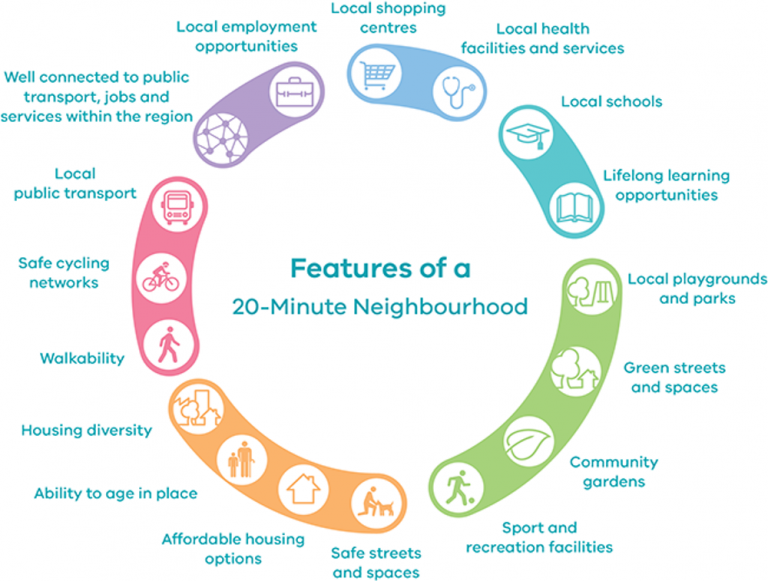
The image from the work done in Melbourne Australia (this link will take you away from our website) shows the interconnectedness of the features that could make up a 20-minute neighbourhood. A key finding from this work as it emerges, is the importance of collaboration. Enabling 20-minute neighbourhoods to emerge takes a vision and commitment from across local government agencies, third sector, corporate sector and vitality the local community itself. The vision itself needs to be ambitious everyone within that community. Involving disabled people from the start will ensure good accessibility which helps everyone.
The Place Standard (this link will take you away from our website) is a tool designed to support conversations across sectors and communities whether they are existing or being developed from new and can act as a valuable resource to examine a route to 20-minute community development. In many ways it stands on the shoulders of good practice across Scotland but enables a national ambition.
Communities, even new ones are not blank canvases either. They are full of the assets of those who have come together there, of shared histories and new ones. The risk of national approaches is that the “professionals” unintentionally miss the assets, because traditionally we have focussed on deficits (like needs assessments). Asset based community development (this link will take you away from our website) turns the traditional approaches on their heads and seek to increase interdependencies within communities and this in turn builds social capital. All of this will be important in nurturing the growth of that deeper sense of neighbourhood.
This is a concept that requires a long-term commitment, beyond political lifetimes, and may fall fowl of that. Engaged communities can sustain beyond policies and politics. The approach risks leaving behind rural communities, some who will not doubt have some sense of neighbourhood but can be very isolated and far from the supports that are crucial parts of the urban concept; like medical facilities, banks, public transport and so on. Can rural communities learn from the approach and build digital support where geography does not enable face to face?
I’m very much looking forward to these sessions, covering the key areas I have mentioned. There is much to learn here and for me, much to be excited about.
This Opinion is part of a specially commissioned series by the ALLIANCE’s Academy programme which accompanies the Academy summer event series Exploring Scotland’s 20-minute neighbourhoods delivered in partnership with MACS and Disability Equality Scotland (DES).
End of page.
You may also like:
Irene Mackintosh, CEO at Mhor Collective shares highlights and hopes for rights in a digital age.
Continue readingIn her latest TFN column, our Chief Officer Sara Redmond reflects on the proposal to collapse Scotland's 14 regional health boards into two.
Continue readingWhen we listen to lived experience, we create better resources, challenge assumptions and help create safer communities for everyone.
Continue readingGozie reflects on supporting citizen engagement, digital inclusion and hopes for the future.
Continue readingDCP member and Project Co-ordinator Esther Misajel shares Pachedu's journey towards digital inclusion.
Continue readingChris Mackie, Director of Digital, reflects on what ALISS has achieved so far this year and shares what is still to come.
Continue readingAt the ALLIANCE and beyond, true and meaningful policy reform means turning people's experiences into lasting action on the ground.
Continue readingGLP-1s can transform health but without adequate wraparound support, weight loss may come at the cost of nutrition, muscle and wellbeing.
Continue readingSheila Duffy, Chief Executive of ASH Scotland, is appealing for support for proposals to restrict tobacco, vapes and nicotine products.
Continue readingBilly McClean reflects on why SCIC26 offers a vital opportunity to learn together, share what works, and shape the future of integrated care
Continue readingTo mark the ALLIANCE's 20 year anniversary Paul Okroj reflects on the importance of supported self management.
Continue readingTo mark Scottish Learning Disability Week (7 - 13 September), Bruce Adamson reflects on this year's call to action.
Continue readingIn her latest TFN column, our Chief Officer Sara Redmond reflects on the current state of social care in Scotland.
Continue readingKicking off September for the ALLIANCE's 20 year anniversary, Grace reflects on the Self Management Programme
Continue readingSara Redmond, ALLIANCE Chief Officer, on the priorities for 2026's Programme for Government.
Continue readingSandra Auld reflects on the ALLIANCE's people focused impact, collaboration, lived experience, campaigns and lasting change in Scotland.
Continue readingMark shares his experience with gambling harms, and how this intersected with the launch of the ALLIANCE's ScotRGH programme in 2020.
Continue readingProfessor Anna Glasier celebrates 20 years of the ALLIANCE and it's vital role in shaping the Women's Health Plan for Scotland.
Continue readingSara Redmond, ALLIANCE Chief Officer, on the challenges faced by community-led health organisations in delivering prevention.
Continue readingAnnie shares her experience of youth politics, and how SAFE has helped her make connections and makes sense of the world of politics.
Continue readingChloe Craig reflects on how we have helped connect Scotland’s lived experience voice to conversations happening beyond our borders.
Continue readingDr Irene Oldfather reflects on two decades of growth, collaboration, and person centred impact across Scotland and beyond.
Continue readingDisabled people are some of those who suffer most in crises but are ignored in planning. Our 6-step model builds justice throughout.
Continue readingMaisie Peebles shares her experience working with Aberdeenshire Public Health Team on a ‘digital conversations’ project.
Continue readingSara Redmond, ALLIANCE Chief Officer, on why the Scottish Government and parties must seize the opportunity for change.
Continue reading