
“Then came those three words I will never forget. “I believe you””
The ALLIANCE Humans of Scotland, shares and showcases short stories about the everyday lives of the people we engage with.
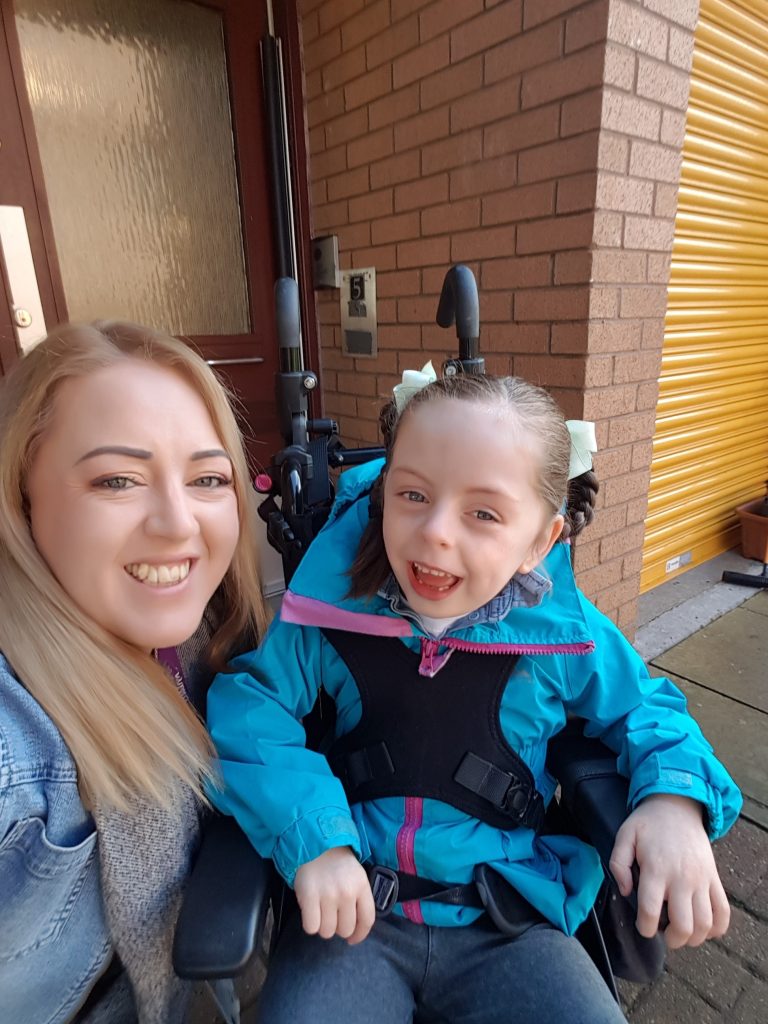
My name is Rebecca and I am amongst many other things Mum to Hannah who is almost 6. I use our experiences over the last 6 years to speak publicly about The Power of The Parent Voice and How important it is in the context of in Person Centred and Collaborative Health and Social Care, and co-production. Specifically, under the banner of co-production when dealing with rare conditions. In Hannah’s case I am her voice as she doesn’t have one.
It’s a difficult thing, to admit to yourself that you think there is something wrong with your child. It’s harder again to say that statement out loud to your loved ones or health professionals. It becomes a battlefield when those professionals repeatedly dismiss your concerns. It took strength I didn’t know I possessed to persevere for 18 months in the face of accusations of Munchausen’s by proxy and statements such as “I can assure you Mrs Pender, there is categorically nothing wrong your child, she is just lazy” and “you’re a paranoid, sleep deprived first time mum”
I started to question my own sanity, whether I was crazy and whether my daughter inability to crawl, walk or babble by 18 months was simply down to bad parenting or was something else really amiss. My heart and my gut knew differently and so I soldiered on. We wiped the slate and changed our medical practice and our health visitor. I invited the new health visitor to our house to see my daughter and I let it all out. Then came those three words I will never forget. “I believe you”. I finally had an ally. Blood tests were ordered to rule out genetic causes in the first instance. And so, we waited.
In October 2014 the phone rang. It was her new paediatrician. She mentioned the blood tests and how the Microarray picked up small variants on Chromosomes and most of the time these were benign, didn’t mean anything however Hannah’s findings were significant. I stood there and let the tears fall. A mixture of heartbreak that my daughter did have something wrong with her and it was confirmed my child was disabled, and of relief that my daughter did have something wrong with her. I felt vindicated, I wasn’t crazy, paranoid, delusional, though I was sleep deprived and I still am. I wasn’t projecting and most importantly I was right and had advocated so strongly on her behalf and it paid off.
It’s very important to understand that I am not here to vilify our healthcare system. Its world class and has saved my daughter’s life on countless occasions and she is kept alive and healthy because she has access to daily meds, oxygen and emergency care at point of need. We are very lucky. But that doesn’t mean there are not improvements that can be made in practice and the attitudinal culture of hierarchy which sometimes exists.
In November 2014, I took Hannah to see 6 GP’s over the course of 10 days and was repeatedly turned away with
“It’s just viral, treat with Calpol, return if she gets worse”
So, I did return, repeatedly. Some were my own GP practice, and some were out of hours services. It wasn’t until day 10 and GP#6, that I demanded immediate action, I explained that I am sure it was viral, but it’s not going away and she is worsening. The Doctor said that although Hannah was clinically fine she would write a letter for her to be seen at A+E if it would make ME feel better.
They checked her temp and it had gone up to 39.3 so we were immediately taken through. We were explaining to the doctor what had been going on when I notice her hands had gone blue, she went limp and started to seize in my arms.
Hannah seized for over 40 minutes and aspirated her stomach contents. It didn’t stop until she was ventilated. She spent 5 days on life support and we were unsure if she would pull through or not, and if she did, would there be any neurological impairment further to her already lengthening list of DXs.
I am forever grateful for that resus team, because of them she is still alive today. Because of their quick action they saved her life. However, they were only able to act so quickly because we were already at the hospital after I had demanded we be seen. It was a team effort. We all saved her life that day. But I shouldn’t have had to push so hard for it to be taken seriously. She had RSV and a chest infection which should have been picked up on examination before it ever got to the life and death scenario we had just endured.
Something needs to fundamentally change within our system. There needs to be more awareness surrounding rare diseases and conditions and what they mean for people. I’ve lost count the amount of times I given her medical history, got to her genetic diagnosis and been met with a blank look. A doctor once asked me if she would grow out of it.
We need to leave ego and hierarchy at the door and work together and listen to each other to ensure that carers and those with disabilities are not let down. We need to invest time in carers, helping them find their confidence to effectively advocate for their children. Encouraging them to not only find their voices but teach them how to harness it and use it effectively to advocate for change and inclusion. It’s not parents’ vs professionals, its figuring out how we can work together to achieve better outcomes for everyone. It’s about highlighting the benefits of coproduction to ensure all needs are met. It’s also about health professionals using one of the most useful tools in their arsenal for fighting rare diseases. The patients and their families.
We can’t continue the way we are currently. Health professionals are overworked and overstretched, stressed, tired and at risk of burnout. So are parents and Carers of those with profound and multiple disabilities and rare conditions. We are all in the same boat. If we work together we can raise the bar beyond what ever seemed conceivable. We are on the precipice of change and the future of person-centred care is still able to be re-written, by listening and having an even playing field with those polished by their profession and those who are experts by daily experience, the possibilities are limitless.
The recurring theme from our experiences is painfully clear. I am not being listened too. I don’t have a degree in medicine, I haven’t been a specialist in genetics, paediatrics or emergency care however I spend 24 hours a day, 7 days a week with my child and I know her better than any degree could ever give me. I am my children’s voice and I am not being heard. Recently someone who works within paediatric health told me that staff in universal services are finding it increasingly difficult to refer children with issues in to specialist services as those services have tightened their criteria so much that it makes it almost impossible for them. What happened to the policy of getting it right for every child?
I want to make a difference. Not just by raising awareness but I don’t want future families to have to endure the emotional torture that our family did and get to the diagnosis without so much as a “Sorry, we were wrong. Your child has a genetic condition, we don’t know anything about it, here is a flyer for Unique who can give you more information, your now discharged from genetics”.
Let’s learn to listen to parents, listen to the experts in their own bodies and their own children. Listen to people describing their symptoms and asking for help. Let’s think outside the box rather than take a wait and see approach. Let’s stop allowing parents to question their ability to parent and allow them to advocate on their child’s behalf and be truly heard. Let’s take a step back and look at the bigger picture and truly place the best interests of these people at the heart of their care. Let’s not keep making the same mistakes of the past and stop an unnecessary rollercoaster of misdiagnosis or refusal to diagnose therefore stopping the access to the right medical and emotional support required to allow them to flourish.
Read more Humans of Scotland stories on our website.
End of page.
You may also like:
“Treating family support as a core part of the service, not an add-on, strengthens outcomes for everyone involved.”
Continue reading"Bringing lived experience into what would usually be a very clinically focused event created lots of opportunity for shared learning."
Continue readingHighlighting real-life stories that demonstrate what GIRFEC can look like in practice.
Continue reading“Working collaboratively has increased the value of what we offer and made our message that much stronger.”
Continue reading"Decisions are made collaboratively, in the best interest of child and family, ensuring clinical safety."
Continue reading"Working in collaboration with local people is the most viable way of ensuring that we are focusing on the outcomes that really matter."
Continue reading"Lingo Flamingo run language learning projects in care homes and day centres to enhance the wellbeing of marginalised adults in care."
Continue readingNicola Cooper, Head of Digital Futures at Scottish Care, taking stock on our 20th Anniversary.
Continue reading“Our integration is built into how we operate, not bolted on as a reporting requirement.”
Continue reading“Set clear goals, communicate openly, stay flexible, and keep learning. Success comes from collaboration and continuous improvement!”
Continue reading"By sharing learning, resources and local knowledge, we aim to grow in a way that is sustainable, flexible & responsive to local priorities"
Continue reading“This project has amplified how important the power of connection is."
Continue reading"This is a unique opportunity to lead Scotland into a new era care model benefitting rural communities and hospital services alike.”
Continue readingLGBT Youth Scotland’s Smash Up experiences of wellbeing in school/college.
Continue reading"Listen first and build services and support around the feedback from the community."
Continue reading“It can be easy to focus on what you can get from a relationship but learning who’s out there and the needs they meet is valuable."
Continue reading“Ultimately, our aim is to empower every young person we work with to achieve their goals and play an active role in their communities."
Continue reading“There is no magic potion in what we do, but we are managing to do it well for the past 30 years.”
Continue reading“We could not do the work we do without the support of other organisations across Glasgow.”
Continue reading“Their mission is to fight food poverty, tackle isolation and discrimination and unite the community through grassroots action.”
Continue readingLouise tells us how Long Term Conditions Hebrides has enabled her to take the lead in managing her health.
Continue reading"When we listen to people, build relationships, and work together across sectors, we can create meaningful, lasting change."
Continue reading"The people who come to the classes have created a community environment....the social aspects are just as important as the exercise."
Continue reading“By collaborating, we can tackle shared challenges, create meaningful solutions, and ensure better outcomes for communities.”
Continue reading“One of the most important lessons we’ve learned is not to assume we know what the community needs”
Continue reading