
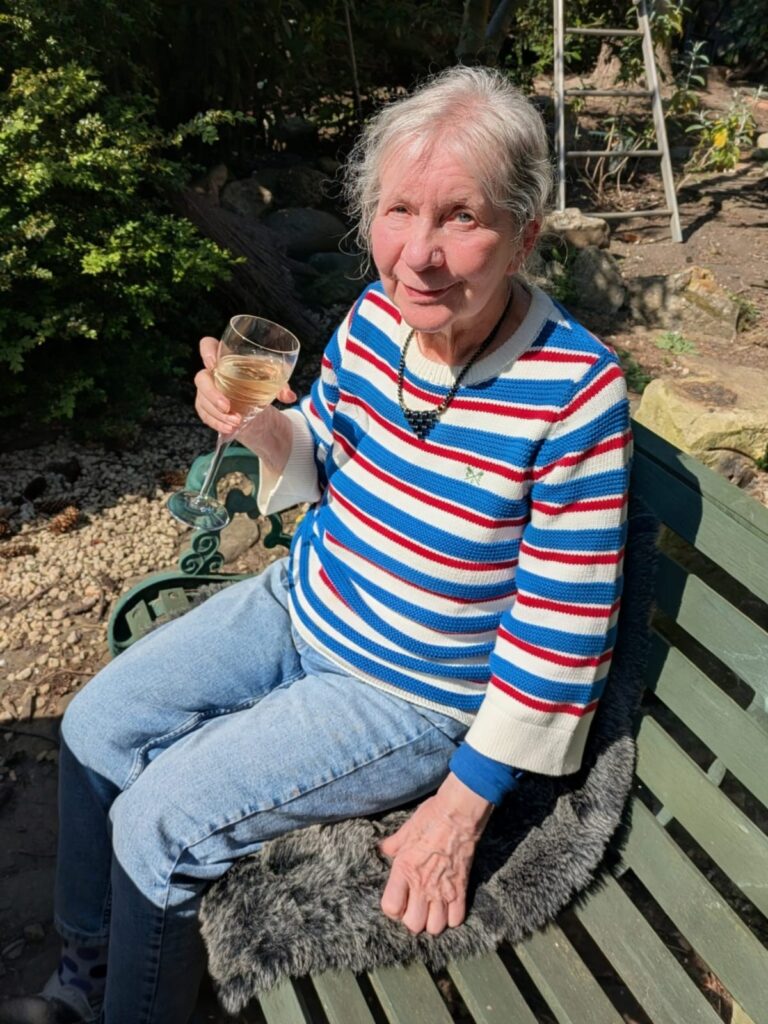
Euan’s story
Euan tells the story of Dot, his Mum, and her experience with dementia, and shares a heartwarming poem read by Dot herself.
I have very vague memories of my grandmother. I think I can remember meeting her when I was about three years old, but this may be a figment of my imagination; she died that same year.
What I do remember, though, is how my mum talked about her. She spoke so fondly of her while I was growing up: what a lovely woman she was, what great times they had together, how much laughter and warmth filled their home. And she spoke, too, about how cruelly she was taken away by dementia. How horrible it was to watch her journey. How painful it was to see the person you have shared so many memories with disappear in front of your eyes.
Those stories stayed with my mum. They shaped her. And, in time, they became her greatest fear.
There was a moment in my mid teens when I truly began to understand just how deep that fear ran. It came from a comment I made, a comment that, if I could go back in time and take back, I would in an instant.
I walked into our lovely family cottage and said something to my mum, something small and ordinary. She questioned it innocently, casually, and my reply still haunts me. “For goodness sake Mum, I have told you this already. Have you got dementia or something?”
I had never seen her react like that before. Tears flowed instantly. She screamed at me. She told me never to say that again. It was her biggest fear. And in that moment, I felt horrendous.
My mum was and is an amazing woman. A great mother and wife. My sister and I grew up feeling supported and loved; she would do anything for her family. She gave up her job in 1990 to look after me after I was knocked over by a car. She was a Sunday School teacher, an Elder of the Church, President of the Guild. She loved history, and later in life she found joy in holidays to Egypt, finally seeing the pyramids she had read about for years. She had been with my dad since she was seventeen, teenage sweethearts who built a life together.
She adored her grandchildren as well, especially taking them out on little adventures. She worked at Lakeland Ltd on George Street in Edinburgh, where she was one of the girls, always up for a laugh and a night out with the team. She had a full life, a busy life, a life rooted in people and purpose.
But things started to change in 2017.
I was on holiday in Bournemouth. I called my mum every night for a chat, the way I always did. But every night she asked where I was, and every night she reacted with surprise when I told her I was in Bournemouth and that I was on holiday. Something was not right. It was not like her.
When I got home, I mentioned it to my dad. He brushed it off at first, maybe a urine infection, maybe stress, maybe nothing. But as the months went on, things did not get better. They got worse. And looking back, it feels more like he was in denial than anything else. My mum had just retired. My dad was still working. Life was supposed to be opening up for them, not closing in.
It was not until around 2020 that my dad told us she had been diagnosed with Alzheimer’s. By then, the signs were impossible to ignore. The decline, and the stages of decline, seemed to be happening so quickly. Every time she slipped into a new stage, we found ourselves thinking this is terrible, but at the same time, we would have given anything to go back to the stage before.
The stages came one after another, each one stealing a little more of the woman we knew.
First came the drinking. She would always ask for a wine, then down it quickly, and sometimes pick up someone else’s glass thinking it was her own. I assume it made her feel relaxed, less anxious, less aware of the confusion creeping in.
Then came the phone calls. She would call people, including me, five or six times a day, asking the same questions. I always changed the way I answered so it did not sound like I was repeating myself. I knew she was not really looking for information; she was trying to stop the loneliness, the isolation, the fear.
Then the runs in the car. Every day at 2pm, no matter what she was doing, she would ask my dad to take her out for a drive. And she would get angry if it did not happen. I have since learned that this is common, the movement, the scenery, the distraction helps quiet the thoughts and the anxiety.
Then came the questions about her mum and dad. She would ask where they were, when they were coming, as if time had folded in on itself.
And now, the frustration has started. There are no conversations anymore. Our beautiful mum, the woman who used to go to Jenners every few weeks for a haircut and style, no longer brushes her hair. She cannot hold a conversation. She cannot connect the way she once did. My dad has now retired, and they never got to enjoy their retirement together.
The isolation and loneliness are real. Friends dropped away so quickly. People she had known for years simply stopped being in touch. After her diagnosis, it was as if everyone thought it was better to stay away, to bury their heads in the sand. If my mum knew what was going on, I know she would be devastated. She would be heartbroken to know that my dad, at eighty three, is carrying all of this, primarily, on his own. She would be telling her friends that she needed them now more than ever, because she is and always will be Dorothy or as she was known, Dot.
I tried to bring my mum’s journey to life in a poem, a way of capturing her story before it slipped away. She narrated it for me a few years ago, not knowing that it was based on her, and she did it beautifully. Hearing her, steady and warm, telling her own story, Her voice. Her journey. Her truth.
This is what matters to me!
Listen to Euan’s Mum recite his poem in the video below.
End of page.