
Future of Social Care – I met an alien from outer space yesterday
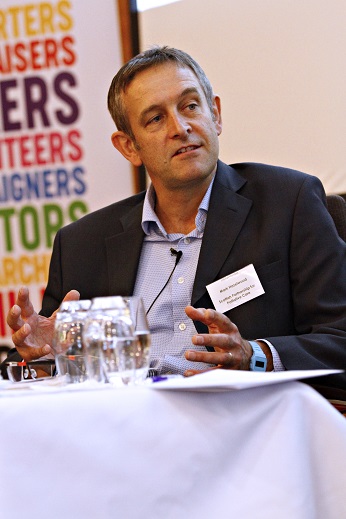
- Written by: Mark Hazelwood — Scottish Partnership for Palliative Care — CEO
- Published: 25th October 2021

Mark Hazelwood, CEO of Scottish Partnership for Palliative Care reflects on end of life care as part of social care support.
Everyone dies. In Scotland 60 000 people die each year. One in every three acute hospital beds is being used to provide important care for someone in their last year of life. The majority of people in care homes for older people are in their last 18 months of life. 30,000 older people with frailty receive care at home support each week. People approaching the end of life are the biggest single group of people needing social care support. I’ll likely need this support, and so too will you. Improving care for people at this stage of life will be a very good litmus for the success of the reforms in totality, but how can that success be achieved?
People want to live well for as long as they can, even and especially when their remaining time may be short. The provision of adequate social care can make it possible for someone living with serious illness to maximise independence and quality of life, even as their health declines. Social care also supports people who are informal/family carers, often making the difference between a role which is tough but sustainable and a role which ends in crisis, collapse and hospital admission. Social care staff can also play an important role in anticipatory care conversations and planning. Key social care supports to people approaching the end of life include care homes, care at home, respite care and housing support.
The proposals for the National Care Service are welcome in their ambition, and in the attempt to begin to flesh out how necessary and overdue change can be achieved. There is a huge amount of devil in the current (and yet to be defined) detail, but that is inevitable given the scale and complexity of change envisioned for processes, organisations and cultures. Here are four things which will be important in determining whether a reformed social care system for people approaching the end of life will live up to the ambitions:
- Firstly, and very obviously, the adequacy of the announced funding to support social care reform/improvement needs to be kept under review and probably increased. Death is inevitable and so are higher taxes if we are to have a health and social care system fit for purpose.
- Secondly, the workforce agenda needs to be given priority. Beyond the broad issues of pay and status there’s a need to think deeply about wellbeing. An important dimension within wellbeing is how staff who encounter death, dying and loss repeatedly in their work are equipped, supported and sustained.
- Thirdly, there is a need to ensure that the well-documented factors which have limited the effectiveness of IJBs are addressed and not simply transplanted into the new Community Health and Social Care Boards (CHSCBs). There is a need to consider how to ensure: collaborative leadership; strategic capacity; continuity in senior roles; and budgeting and planning which is integrated, long term and focussed on outcomes.
- Finally, if the care for people approaching the end of life is to improve, the new approach needs to meet an “alien from outer space” test. Don’t worry, this isn’t a new policy initiative from Priti Patel’s Home Office. Rather, an alien from outer space arriving in Scotland should be able to look at our health and care system and clearly see straight away that care for people at the end of life is a big deal. The alien should be able to look at policies and strategies and see that this is an area of explicit and priority focus for the National Care Service and for the reformed local planning and commissioning bodies. The alien should see a system which measures and understands peoples experiences at the end of life, and which uses these experiences to inform planning and commissioning which takes a population systemwide approach. They should see commissioning which identifies and works collaboratively towards delivering better outcomes for this phase of life.
Yesterday I met a recently arrived alien from outer space. Based on what she could see of our health and care system she had assumed that most humans must be immortal. For this to change we need a political, policy and planning focus just as much as we need structural and process reform.
You can read more about improving people’s experiences of living with serious illness, dying and bereavement in SPPC’s new report Every Story’s Ending (this link takes you away from the ALLIANCE website).
End of page.
You may also like:
As part of our 20 year anniversary, the Integration Team highlight the importance of our Connected Communities series.
Continue readingTo mark ‘What matters to you?’ Day, The ALLIANCE's Barbara Flynn considers the impact of Tommy Whitelaw’s talks for nurses and midwives.
Continue readingThe ALLIANCE’s Humans of Scotland project works to challenge stigma.
Continue readingIn her latest TFN column, our Chief Officer Sara Redmond reflects on post election feelings and Scotland’s future.
Continue readingALLIANCE Chief Officer, Sara Redmond, reflects on our Annual Conference 2026 and how we're turning hope into action.
Continue readingALLIANCE member, Catherine, shares the importance of initiatives like 'What Matters To You?' Day in promoting person centred care.
Continue readingLearn about how the ALLIANCE has championed joined-up, person centred care.
Continue readingDementia Action Week highlighted some great resources and support for people living with dementia and their family, friends, and carers.
Continue readingSteven Mair gives us an insight into his role as a gamer at the Glasgow Children’s Hospital Charity.
Continue readingSince 2009, ALISS has helped people find local health and wellbeing support. Any group, big or small, can add their information.
Continue readingThe new Scottish Government must turn promises into action to improve hospice and palliative care
Continue readingTogether, we can create lasting change for everyone living with Crohn’s or Colitis.
Continue readingFind out more about these digital self management tools and how to get in touch to arrange an information session.
Continue readingOur Chief Officer Sara Redmond addresses recent commentary on the relationship between Government and the Third Sector.
Continue readingCornell explores how we can build an environmental human rights-based culture
Continue readingLouise Coupland, Digital Health and Social Care Programme Manager shares her opinions on the national roll out of MyCare.scot.
Continue readingChris Mackie, Director of Digital, looks back at how ALISS has developed, grown, and innovated over time.
Continue readingCrohn’s and Colitis care in Scotland is at a pivotal moment. Urgent action is needed to tackle delays and poor access to vital services
Continue readingThe ALLIANCE’s Lewis Shaw reflects on the importance of rehabilitation support.
Continue readingIsabella Goldie of Deafblind Scotland reflects on the value of partnership work.
Continue readingFind out more about the inaugural Power of Attorney Day taking place on 22 April 2026.
Continue readingDr Hannah Tweed reflects on 20 years of the Scottish Sensory Hub, the important work they do and why it matters.
Continue readingAs part of our 20 year anniversary, Kerry shares her reflections on how far the ALLIANCE has come, our achievements, and our impact.
Continue readingIn her latest TFN column, our Chief Officer Sara Redmond reflects on 20 years since Scotland moved to put children at the centre of policy.
Continue readingCancer care in Scotland is at a critical moment. Macmillan is calling for urgent action ahead of the parliamentary elections in May
Continue reading