
Future of Social Care – Building a national service that cares in the small places
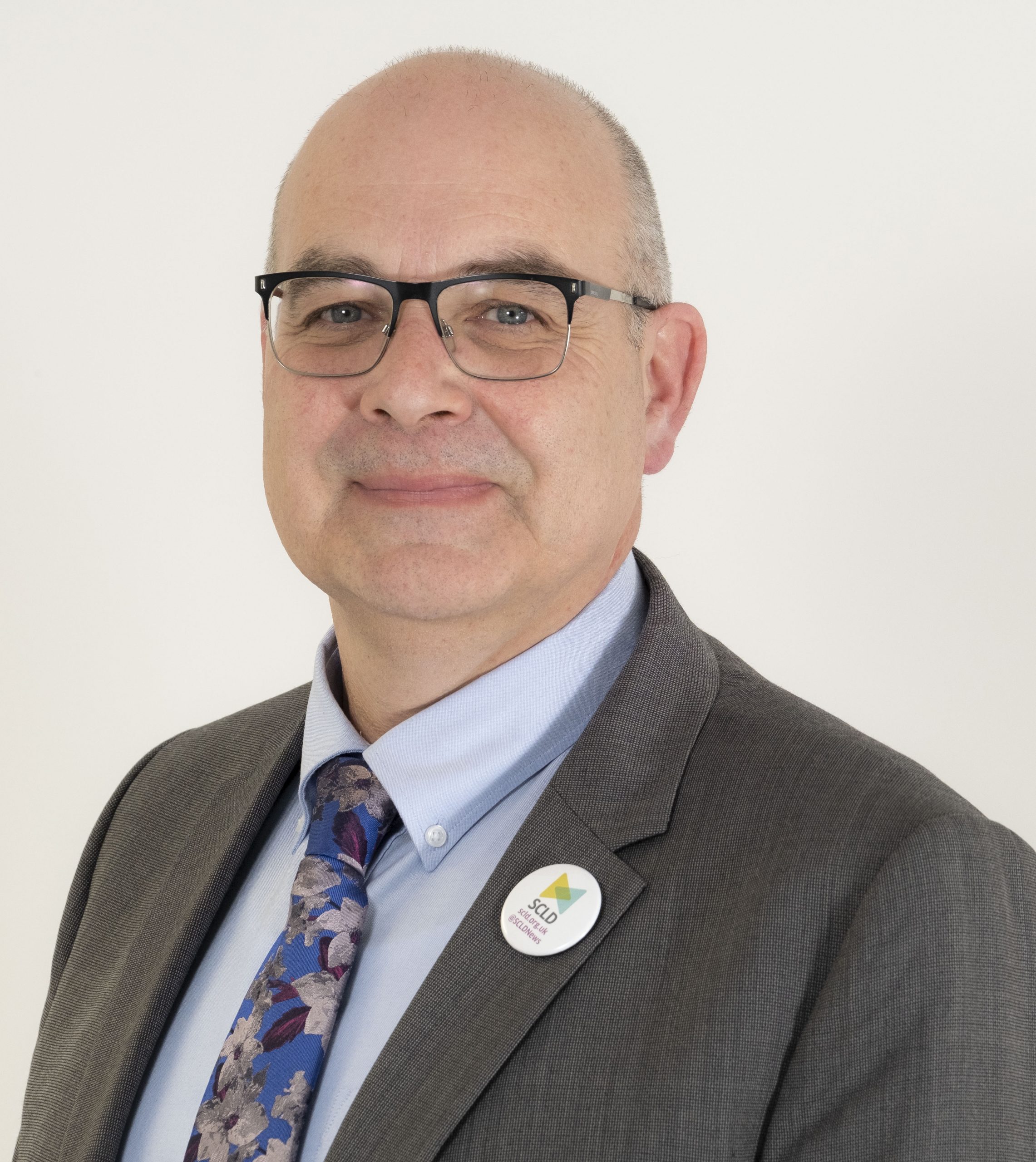
- Written by: Charlie McMillan — Scottish Commission for Learning Disability (SCLD) — Chief Executive
- Published: 28th October 2021

Charlie McMillan of SCLD asks how do we turn an increasingly thread-bare safety net into a vibrant springboard?
When Derek Feeley launched the Independent Review of Adult Social Care, he said that the review group had adopted something of an informal mantra: “Social care is not a safety net, it is a springboard.”
This was gratifying to the member of the Expert Group who said this and to the many other SCLD stakeholders who took part in the Review. Everyone who was involved was clear that the status quo is not working. All the evidence we have reinforces this. We believe this simple statement encapsulated so much of the challenge we all face as we turn to consider what a national care service might look like. How do we turn an increasingly thread-bare safety net into a vibrant springboard?
There was also a clear sense amongst people with learning disabilities and their supporters that the Review was a process that had truly listened to their voices and had recognised that their human rights had to be at the very heart of whatever came next.
Now, however, many of our stakeholders are concerned by the widened focus of the initial consultation for the proposed National Care Service and on the challenging timescales for response. Feeley himself was clear that people with learning disabilities needed to be involved in the development of the National Care Service – timescales that allow this to happen are therefore essential.
People are also concerned that the current consultation risks diluting the transformative spirit of the Feeley Review with a focus on creating bureaucratic systems where those who require the support most remain invisible.
If we believe social care should be based on the realisation of fundamental human rights, we must bear in mind the words of Eleanor Roosevelt who said that human rights must begin in the “small places, close to home.” For us, this means a system of social care which addresses the problems faced by individuals, in the communities they live, before they arise. We have heard so many accounts of where this does not happen, both before and during the pandemic.
It is also important to remember that for many people with learning disabilities and their family carers, the pandemic is far from over. Support is still to return to pre-pandemic levels, many respite and day services remain closed, health care and education remain inaccessible, transitions from education are patchy at best, and employment for people with learning disabilities is the exception rather than the rule. Added to this is the fact that entitlement to social care currently does not follow the person should they move area and, at its worst, lacks even the most basic flexibility in supporting people to achieve their future goals and aspirations.
SCLD believes that more than being a failure of policy and practice these, and the other systemic barriers that people with learning disabilities experience, are failures of culture, of values, attitudes, as well as inclusion and belonging. We believe we do not just need a new system of social care support, but a whole new story and a means to make that story a reality for people.
We know that many people continue to think that those supported by social care are static recipients in institutional settings, rather than individuals with talents and strengths which they can use to contribute to the social fabric of our communities when properly supported. Where people with learning disabilities do live in our communities, they tend to live their life on the margins, segregated and excluded by the very communities they long to belong to.
Resolving these issues must be at the core of the establishment of the National Care Service; it must be no less visionary than the thinking that established the National Health Service. It must enable transformative change to the lives of people with learning disabilities, and many more besides.
The discussion about the vision, strategy, form, and function of the National Care Service must be about more than the minutiae of structure and process. It must be about delivering real and lasting cultural change for the country and significant improvements to the quality of life for every person who relies on it.
Therefore, SCLD would recommend the following as building blocks to the design and delivery process:
- Meaningful engagement of people with learning disabilities at every step on the way including in the development of legislation.
- Embedding an equalities and human rights approach to the provision of support and care which is EQIA (Equality Impact Assessment) assessed and focuses on providing flexible support which empowers individuals.
- A clear and consistent approach to the regulation of care and support including a fully accessible mechanisms of complaint for people with learning disabilities.
In short, the National Care Service must be truly human rights focused and person centred. It must be designed and resourced so that it can function as a springboard for all our citizens to live their best lives – in the heart of their ‘small places’ across Scotland.
End of page.
You may also like:
As part of our 20 year anniversary, the Integration Team highlight the importance of our Connected Communities series.
Continue readingTo mark ‘What matters to you?’ Day, The ALLIANCE's Barbara Flynn considers the impact of Tommy Whitelaw’s talks for nurses and midwives.
Continue readingThe ALLIANCE’s Humans of Scotland project works to challenge stigma.
Continue readingIn her latest TFN column, our Chief Officer Sara Redmond reflects on post election feelings and Scotland’s future.
Continue readingALLIANCE Chief Officer, Sara Redmond, reflects on our Annual Conference 2026 and how we're turning hope into action.
Continue readingALLIANCE member, Catherine, shares the importance of initiatives like 'What Matters To You?' Day in promoting person centred care.
Continue readingLearn about how the ALLIANCE has championed joined-up, person centred care.
Continue readingDementia Action Week highlighted some great resources and support for people living with dementia and their family, friends, and carers.
Continue readingSteven Mair gives us an insight into his role as a gamer at the Glasgow Children’s Hospital Charity.
Continue readingSince 2009, ALISS has helped people find local health and wellbeing support. Any group, big or small, can add their information.
Continue readingThe new Scottish Government must turn promises into action to improve hospice and palliative care
Continue readingTogether, we can create lasting change for everyone living with Crohn’s or Colitis.
Continue readingFind out more about these digital self management tools and how to get in touch to arrange an information session.
Continue readingOur Chief Officer Sara Redmond addresses recent commentary on the relationship between Government and the Third Sector.
Continue readingCornell explores how we can build an environmental human rights-based culture
Continue readingLouise Coupland, Digital Health and Social Care Programme Manager shares her opinions on the national roll out of MyCare.scot.
Continue readingChris Mackie, Director of Digital, looks back at how ALISS has developed, grown, and innovated over time.
Continue readingCrohn’s and Colitis care in Scotland is at a pivotal moment. Urgent action is needed to tackle delays and poor access to vital services
Continue readingThe ALLIANCE’s Lewis Shaw reflects on the importance of rehabilitation support.
Continue readingIsabella Goldie of Deafblind Scotland reflects on the value of partnership work.
Continue readingFind out more about the inaugural Power of Attorney Day taking place on 22 April 2026.
Continue readingDr Hannah Tweed reflects on 20 years of the Scottish Sensory Hub, the important work they do and why it matters.
Continue readingAs part of our 20 year anniversary, Kerry shares her reflections on how far the ALLIANCE has come, our achievements, and our impact.
Continue readingIn her latest TFN column, our Chief Officer Sara Redmond reflects on 20 years since Scotland moved to put children at the centre of policy.
Continue readingCancer care in Scotland is at a critical moment. Macmillan is calling for urgent action ahead of the parliamentary elections in May
Continue reading