
Realistic Medicine and You
- Written by: Mary Hucker — Realistic Medicine Team, Scottish Government — Senior Policy Manager
- Published: 10th August 2018
Mary outlines how you can get involved in the Realistic Medicine Team’s new social media campaign.
You may have heard the phrase ‘Realistic Medicine’ being used more often in recent years. When Chief Medical Officer Catherine Calderwood released her first annual report in 2015, Realistic Medicine took the medical world by storm, with over ten million impressions on Twitter and an outpouring of support from the medical community.
What is Realistic Medicine?
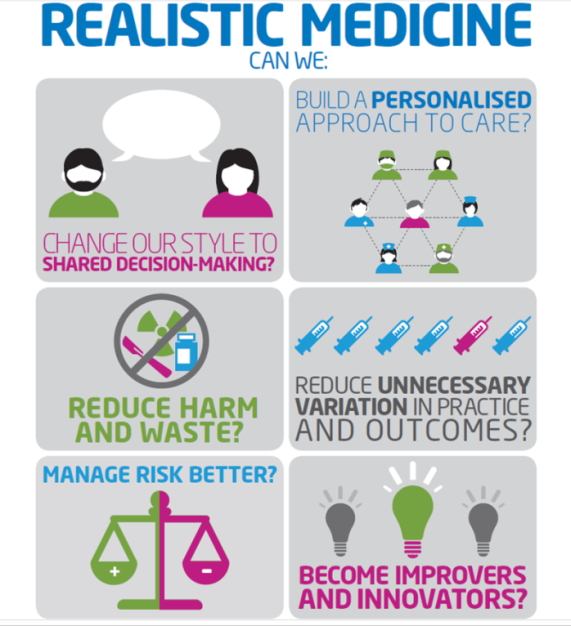
It’s not, as the name might seem to suggest, the opposite of ‘impractical medicine’! We want people working in health and social care, and people who use these services, to think about the values and the behaviours that lead to good experiences. Drawing on these values will help doctors, nurses and care workers to have meaningful conversations with people about their care, and will support staff and patients to base treatment options around what matters most to people.
To achieve this, people using healthcare services and their families must feel empowered to discuss their treatment fully with healthcare professionals, in language that works for them and using information that helps them to understand all their options. Everyone should feel able to ask their healthcare professional why they’ve suggested a test, treatment or procedure, and all decisions about a person’s care should be made jointly between the individual and their healthcare team.
Realistic Medicine puts the person receiving care at the centre of decision-making and creates a supported, personalised approach. It aims to reduce harm and waste while championing innovation and improvement. These concepts are essential to a well-functioning and sustainable NHS for the future.
And that’s where you come in!
The Realistic Medicine Social Media Campaign
We want to hear about your experiences of discussing your heath and care with your doctor, or other members of your healthcare team – the good and the not-so-good, the sad and the uplifting, the times it was easy and the times it was hard.
Please send us a short video clip, about two minutes long, that talks about your experiences of talking with your healthcare professionals. We’ll use some of your videos to create a social media campaign to help other people feel more confident about talking to their healthcare professionals about what really matters to them.
Please note that by sending your videos, you’ll be agreeing for them to be used on social media to promote the need to have more meaningful conversations between professionals and patients. If selected, your video might be edited for length or clarity, and shared on social media – however, we will only use your videos to promote more meaningful conversations.
You can hear more about our campaign by watching Dr Calderwood’s video here (this link will take you away from our website). Please send your videos to my.experience@gov.scot by Monday the 27th of August.
Thank you, and we very much look forward to hearing from you.
End of page.
You may also like:
A child cannot truly feel safe in a school or community if they do not feel that they belong.
Continue readingFor 20 years, The ALLIANCE has listened to member voices to help protect and improve Scotland's care services.
Continue readingWith the ALISS Customisable Map Tool, organisations can share info about community resources in ways that work for the people they support.
Continue readingIrene Mackintosh, CEO at Mhor Collective shares highlights and hopes for rights in a digital age.
Continue readingIn her latest TFN column, our Chief Officer Sara Redmond reflects on the proposal to collapse Scotland's 14 regional health boards into two.
Continue readingWhen we listen to lived experience, we create better resources, challenge assumptions and help create safer communities for everyone.
Continue readingGozie reflects on supporting citizen engagement, digital inclusion and hopes for the future.
Continue readingDCP member and Project Co-ordinator Esther Misajel shares Pachedu's journey towards digital inclusion.
Continue readingChris Mackie, Director of Digital, reflects on what ALISS has achieved so far this year and shares what is still to come.
Continue readingAt the ALLIANCE and beyond, true and meaningful policy reform means turning people's experiences into lasting action on the ground.
Continue readingGLP-1s can transform health but without adequate wraparound support, weight loss may come at the cost of nutrition, muscle and wellbeing.
Continue readingSheila Duffy, Chief Executive of ASH Scotland, is appealing for support for proposals to restrict tobacco, vapes and nicotine products.
Continue readingBilly McClean reflects on why SCIC26 offers a vital opportunity to learn together, share what works, and shape the future of integrated care
Continue readingTo mark the ALLIANCE's 20 year anniversary Paul Okroj reflects on the importance of supported self management.
Continue readingTo mark Scottish Learning Disability Week (7 - 13 September), Bruce Adamson reflects on this year's call to action.
Continue readingIn her latest TFN column, our Chief Officer Sara Redmond reflects on the current state of social care in Scotland.
Continue readingKicking off September for the ALLIANCE's 20 year anniversary, Grace reflects on the Self Management Programme
Continue readingSara Redmond, ALLIANCE Chief Officer, on the priorities for 2026's Programme for Government.
Continue readingSandra Auld reflects on the ALLIANCE's people focused impact, collaboration, lived experience, campaigns and lasting change in Scotland.
Continue readingMark shares his experience with gambling harms, and how this intersected with the launch of the ALLIANCE's ScotRGH programme in 2020.
Continue readingProfessor Anna Glasier celebrates 20 years of the ALLIANCE and it's vital role in shaping the Women's Health Plan for Scotland.
Continue readingSara Redmond, ALLIANCE Chief Officer, on the challenges faced by community-led health organisations in delivering prevention.
Continue readingAnnie shares her experience of youth politics, and how SAFE has helped her make connections and makes sense of the world of politics.
Continue readingChloe Craig reflects on how we have helped connect Scotland’s lived experience voice to conversations happening beyond our borders.
Continue readingDr Irene Oldfather reflects on two decades of growth, collaboration, and person centred impact across Scotland and beyond.
Continue reading