
Dancing with a diagnosis
- Written by: Sarah Potter — Scottish Ballet — Senior Copywriter
- Published: 27th September 2021
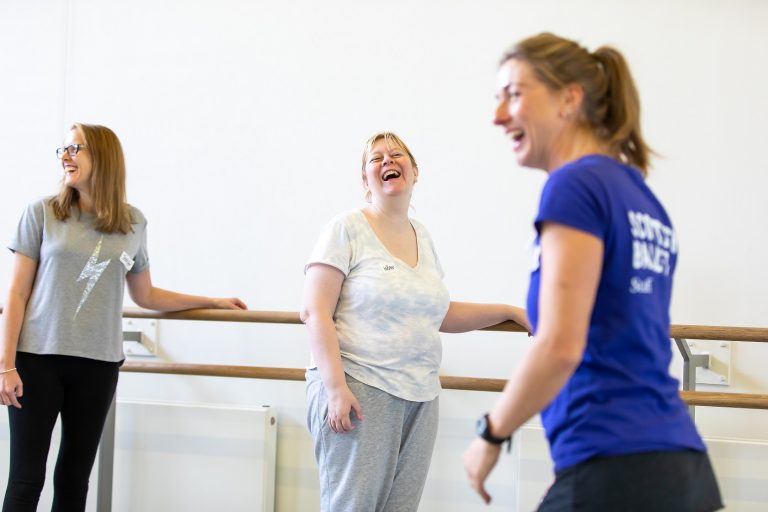
Sarah Potter follows the journey of Heather Eland, from diagnosis to dancing with Scottish Ballet’s Elevate™ programme.
In June 2017, Heather Eland experienced her first multiple sclerosis (MS) symptoms at the age of 38. Following sight loss in one eye, she recalls, ‘the doctor recognised that my eyes weren’t adjusting as they should be and sent me for an MRI scan’.
Three months later, Heather had a relapse. For Heather, the loss of use of her writing hand has had one of the biggest impacts on her quality of life. ‘It’s not just the physical symptoms, it’s the social anxieties that you put on yourself – I know my friends don’t mind cutting my food up for me in a restaurant, but I worry that they do. I know that if I explain to new people that I can’t shake their hand because I have MS, that they will be ok with it – it’s the mind chatter in that moment that is stressful.’
Heather is not alone. Multiple sclerosis is more common in Scotland than most other countries in the world and there are over 15,000 people living with MS in Scotland. Lesions on the brain and spinal cord cause a range of symptoms unique to each person living with the condition. Temperature control, balance and fatigue are all common daily challenges. Heather explains that shortly after her diagnosis in 2018, NHS sent her on a course to manage fatigue, ‘I used to be a go-getter and plan lots of activities in my day. Now I put rest time in my diary’.
In 2019, Heather heard that Scottish Ballet was launching Elevate, a dance programme conceived and designed for people living with MS. Scottish Ballet’s Health Team consulted with academics, researchers and MS specialists in Glasgow, Florida, and Washington to create something completely pioneering.
Heather took part in research carried out by Dr Bethany Whiteside, Royal Conservatoire of Scotland, during a 10-week pilot phase. The study by Dr Whiteside shows a marked trend towards a perceived improvement in balance, demonstrates a statistically significant reduction in perceived fatigue levels and a marked trend towards an improvement in perceived walking ability.
Dr Whiteside’s research also found that many participant dancers in the pilot study had never attended an MS specific activity prior to Elevate and had lived with a diagnosis for more than ten years.
The pandemic magnified isolation. Consultant Neurologist and Director of Tayside MS Research Unit, Dr Jonathan O’Riordan said, ‘it became clear that MS patients were suffering more than most during lockdown. It seemed as if there was no respite. Scottish Ballet’s online provision of Elevate during the pandemic meant that those, often confined to their own home, could reach out into a different world of music, vitality, and hope. Patients continue to report that the combination of music and movement re engages their physical and emotional wellbeing’.
For some people living with MS, Elevate has been a welcome follow-up from physiotherapy. For many, dance is often a key motivation for joining. Heather says, ‘dancing again has been pretty emotional, I didn’t realise I was missing that part of me. Elevate has given me back this skill and love of dance. In class, I’m transported to wherever the music takes me. There’s a lightness. Suddenly my right arm acts instinctively; gliding like a falling leaf at the teacher’s suggestion. No matter what is going on in my life, the hour I dance, it’s just for me, I have no other worries in that moment. Choosing to dance has been empowering’.
Scottish Ballet’s Senior Dance Health Manager, Lisa Sinclair, comments, ‘I am always moved to hear people living with MS speak so honestly about how the effects of Elevate are being lived and felt way beyond the studio. That is why we do this’.
Dance is a living, breathing artform, but it does not stop there. After class, everyone stays on for Social Café. ‘I didn’t know I was looking for that reassurance’, Heather says of her Elevate peers. The Glasgow dancers have created a WhatsApp group called Ballet Babes, where posts include everything from positive memes for the day, to experience of drug treatment, or using wheelchairs.
Heather’s message to anyone living with MS is, ‘Come along and try Elevate. It is open to everyone, no matter what your symptoms are. Everyone at Scottish Ballet will make you feel welcome. It might be daunting at first because it’s so unlike anything else, but soon you will be moving your body in ways that you wouldn’t anywhere else. You will realise you are capable of trying new things after all’.
All Scottish Ballet’s Health classes are inspired by the company’s repertoire, so if you join this autumn, you will learn moves from Starstruck – a lovingly revived Gene Kelly ballet.
Weekly Elevate classes are still running on Zoom. Plans for live, in-person sessions in Glasgow, Tayside and Orkney are to resume alongside a digital offering in spring 2022. If you would like to join an Elevate class, please contact dancehealth@scottishballet.co.uk (this link will take you away from our website)
Acknowledgements
Elevate™ has been made possible by generous support from The R S Macdonald Trust, Baillie Gifford (Scottish Ballet’s SB Health (neurological) Partner), The Robertson Trust and patrons of Scottish Ballet.
This year, The Health and Social Care Alliance Scotland have funded Scottish Ballet to create a new digital dance resource so that people living with a neurological condition can dance from their bed or bedside.
End of page.
You may also like:
Dr Anthony McMahon reflects on the importance of the Community Links Worker within his GP surgery - and why it makes all the difference.
Continue readingAs part of our 20 year anniversary, the Integration Team highlight the importance of our Connected Communities series.
Continue readingTo mark ‘What matters to you?’ Day, The ALLIANCE's Barbara Flynn considers the impact of Tommy Whitelaw’s talks for nurses and midwives.
Continue readingThe ALLIANCE’s Humans of Scotland project works to challenge stigma.
Continue readingIn her latest TFN column, our Chief Officer Sara Redmond reflects on post election feelings and Scotland’s future.
Continue readingALLIANCE Chief Officer, Sara Redmond, reflects on our Annual Conference 2026 and how we're turning hope into action.
Continue readingALLIANCE member, Catherine, shares the importance of initiatives like 'What Matters To You?' Day in promoting person centred care.
Continue readingLearn about how the ALLIANCE has championed joined-up, person centred care.
Continue readingDementia Action Week highlighted some great resources and support for people living with dementia and their family, friends, and carers.
Continue readingSteven Mair gives us an insight into his role as a gamer at the Glasgow Children’s Hospital Charity.
Continue readingSince 2009, ALISS has helped people find local health and wellbeing support. Any group, big or small, can add their information.
Continue readingThe new Scottish Government must turn promises into action to improve hospice and palliative care
Continue readingTogether, we can create lasting change for everyone living with Crohn’s or Colitis.
Continue readingFind out more about these digital self management tools and how to get in touch to arrange an information session.
Continue readingOur Chief Officer Sara Redmond addresses recent commentary on the relationship between Government and the Third Sector.
Continue readingCornell explores how we can build an environmental human rights-based culture
Continue readingLouise Coupland, Digital Health and Social Care Programme Manager shares her opinions on the national roll out of MyCare.scot.
Continue readingChris Mackie, Director of Digital, looks back at how ALISS has developed, grown, and innovated over time.
Continue readingCrohn’s and Colitis care in Scotland is at a pivotal moment. Urgent action is needed to tackle delays and poor access to vital services
Continue readingThe ALLIANCE’s Lewis Shaw reflects on the importance of rehabilitation support.
Continue readingIsabella Goldie of Deafblind Scotland reflects on the value of partnership work.
Continue readingFind out more about the inaugural Power of Attorney Day taking place on 22 April 2026.
Continue readingDr Hannah Tweed reflects on 20 years of the Scottish Sensory Hub, the important work they do and why it matters.
Continue readingAs part of our 20 year anniversary, Kerry shares her reflections on how far the ALLIANCE has come, our achievements, and our impact.
Continue readingIn her latest TFN column, our Chief Officer Sara Redmond reflects on 20 years since Scotland moved to put children at the centre of policy.
Continue reading