
People First (Scotland) members’ views on integration
- Written by: People First (Scotland) —
- Published: 17th June 2018
We need services that communicate with each other and work in cooperation rather than in isolation.
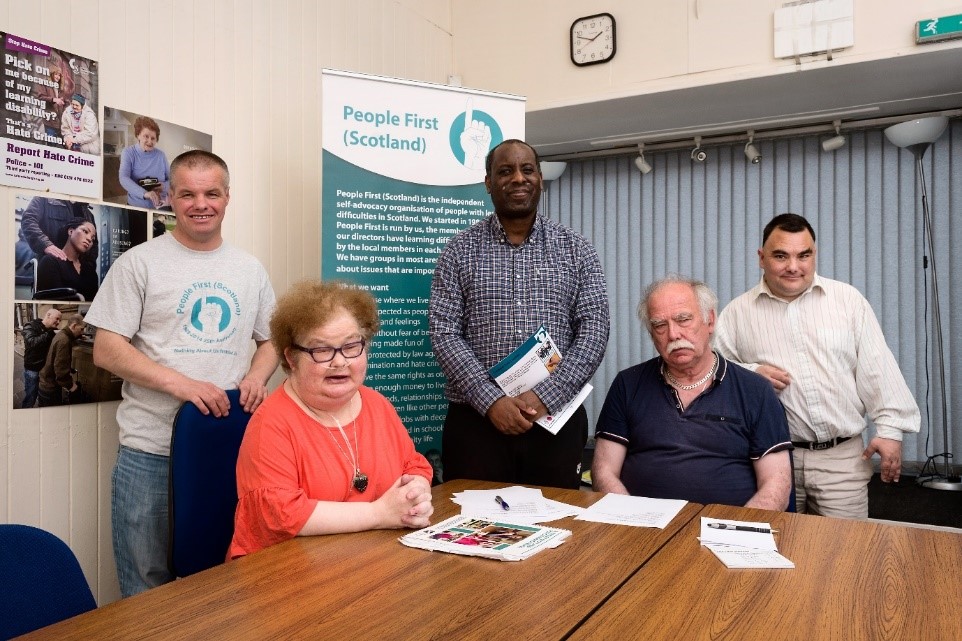
People First (Scotland) works for the human rights of people who have the labels of Learning Disability or Intellectual Impairment. Members of People First spend a massive amount of time looking at ways to challenge poor service provision but also working proactively to offer lived experience, insight, expertise in the design of systems and services. We campaign to establish and protect the same freedom, choice, dignity and control held by other citizens across all areas of life.
The integration of health and social care should or could offer a balanced and whole person approach to meeting support needs. The ambition to develop health and social care systems that really work together, delivering a joined-up service is a positive one. Indeed, we regularly campaign for better support and effective communication about and within it for people with a learning disability.
However, it is hard for us to talk about integration as a concept without talking about member experiences of health and social care in general. The idea of health and social care integration was to improve these experiences and lead to better outcomes but, so far, this has not been the reality for our members.
Within the People First (Scotland) membership we have struggled to find members who have experienced positive change to either the support or the healthcare they receive since integration came into place.
Over the years we have heard lots of different names for support that we might get offered, or the way that plans and payments are put together for support we do or do not end up getting.
These include self-directed support, day options, residential support provision, support for living, individualised support, personalised support, support at home, home care, tailor made support, person-centred support and community care, to name a few.
Often large changes have happened without us being usefully consulted, informed or involved.
Each time that support has been organised differently, or called something new, we have had to deal with a period of change and uncertainty in our lives. We have been through this many times but it does not make the process any easier.
Almost without fail, a change in name, in approach or department has meant that the amount of time on offer, or the availability of the support, has been reduced. Across Scotland, members report that their support is being cut and they are forced to make difficult choices. The choice between support to buy food, support to pay a bill or support to see the doctor. The idea of using support creatively or flexibly simply does not exist for many of us.
We are assessed using eligibility criteria designed to recognise and respond to loss of skill and deterioration rather than our level of need. But it should not matter whether someone requires two hours or 24 hours of support. What we need is support that allows us to live a full and varied life like other members of society. We want to learn, to work, to live as a family, to contribute, but we need fair and equal access to health and social care to make that happen. There are still very few occasions where the real and useful range of support, required throughout life, is on offer.
It is still the case that the structures and processes for most service planning continue to change and proceed without our involvement.
How about starting with the information about services for health and support being offered first of all in an accessible manner? ‘Alternative versions’ can provide less accessible or more specialist information with the expectation that support to access that will be on offer.
We need services that communicate with each other and work in cooperation rather than in isolation. The experience shared by People First members tells us that this reality is still a long way from being realised. People with a learning disability are still living in hospitals because there is no support package in place for them to live in the community. Calling somewhere a unit rather than a ward does not change this.
So, what we share here is frustration. Whatever you call something, it is the life experience of Scottish citizens that shows whether things are right, whether things are working, changing, or heading back towards mistakes made previously.
If there is no expectation that support allows a life, an independent life, with all the ups and downs that brings, then calling what is offered integrated, person centred, or anything else makes no difference. The fact is that people with a learning disability continue to experience poorer outcomes than the rest of society.
What we need is to be involved in planning and decision making. What we want is genuine involvement in decision making, at all levels. This could mean people with a learning disability sitting on IJBs, with those meetings taking place in an accessible way, facilitating meaningful participation. It could mean other, very local planning solutions, but it certainly means Nothing About Us Without Us.
It means politicians and disabled people’s organisations working in co-production to come up with long term solutions that meet the needs of those who use these services.
Finally, and crucially, we need long term investment in health and social care rather than the ongoing reductions in service that we continue to experience. Without that commitment to funding, people with a learning disability will continue to lead poorer, unhealthier lives, will continue to die younger than other citizens, will remain excluded not integrated in so many ways.
This Opinion is part of the ALLIANCE’s ‘We Need To Talk About Integration’ anthology which is available at the link below.
End of page.
You may also like:
A child cannot truly feel safe in a school or community if they do not feel that they belong.
Continue readingFor 20 years, The ALLIANCE has listened to member voices to help protect and improve Scotland's care services.
Continue readingWith the ALISS Customisable Map Tool, organisations can share info about community resources in ways that work for the people they support.
Continue readingIrene Mackintosh, CEO at Mhor Collective shares highlights and hopes for rights in a digital age.
Continue readingIn her latest TFN column, our Chief Officer Sara Redmond reflects on the proposal to collapse Scotland's 14 regional health boards into two.
Continue readingWhen we listen to lived experience, we create better resources, challenge assumptions and help create safer communities for everyone.
Continue readingGozie reflects on supporting citizen engagement, digital inclusion and hopes for the future.
Continue readingDCP member and Project Co-ordinator Esther Misajel shares Pachedu's journey towards digital inclusion.
Continue readingChris Mackie, Director of Digital, reflects on what ALISS has achieved so far this year and shares what is still to come.
Continue readingAt the ALLIANCE and beyond, true and meaningful policy reform means turning people's experiences into lasting action on the ground.
Continue readingGLP-1s can transform health but without adequate wraparound support, weight loss may come at the cost of nutrition, muscle and wellbeing.
Continue readingSheila Duffy, Chief Executive of ASH Scotland, is appealing for support for proposals to restrict tobacco, vapes and nicotine products.
Continue readingBilly McClean reflects on why SCIC26 offers a vital opportunity to learn together, share what works, and shape the future of integrated care
Continue readingTo mark the ALLIANCE's 20 year anniversary Paul Okroj reflects on the importance of supported self management.
Continue readingTo mark Scottish Learning Disability Week (7 - 13 September), Bruce Adamson reflects on this year's call to action.
Continue readingIn her latest TFN column, our Chief Officer Sara Redmond reflects on the current state of social care in Scotland.
Continue readingKicking off September for the ALLIANCE's 20 year anniversary, Grace reflects on the Self Management Programme
Continue readingSara Redmond, ALLIANCE Chief Officer, on the priorities for 2026's Programme for Government.
Continue readingSandra Auld reflects on the ALLIANCE's people focused impact, collaboration, lived experience, campaigns and lasting change in Scotland.
Continue readingMark shares his experience with gambling harms, and how this intersected with the launch of the ALLIANCE's ScotRGH programme in 2020.
Continue readingProfessor Anna Glasier celebrates 20 years of the ALLIANCE and it's vital role in shaping the Women's Health Plan for Scotland.
Continue readingSara Redmond, ALLIANCE Chief Officer, on the challenges faced by community-led health organisations in delivering prevention.
Continue readingAnnie shares her experience of youth politics, and how SAFE has helped her make connections and makes sense of the world of politics.
Continue readingChloe Craig reflects on how we have helped connect Scotland’s lived experience voice to conversations happening beyond our borders.
Continue readingDr Irene Oldfather reflects on two decades of growth, collaboration, and person centred impact across Scotland and beyond.
Continue reading