
The transformative effect of Intelligent Kindness
- Written by: Shaun Maher — Scottish Government — Strategic Advisor for Person Centred Care and Improvement
- Published: 17th November 2022
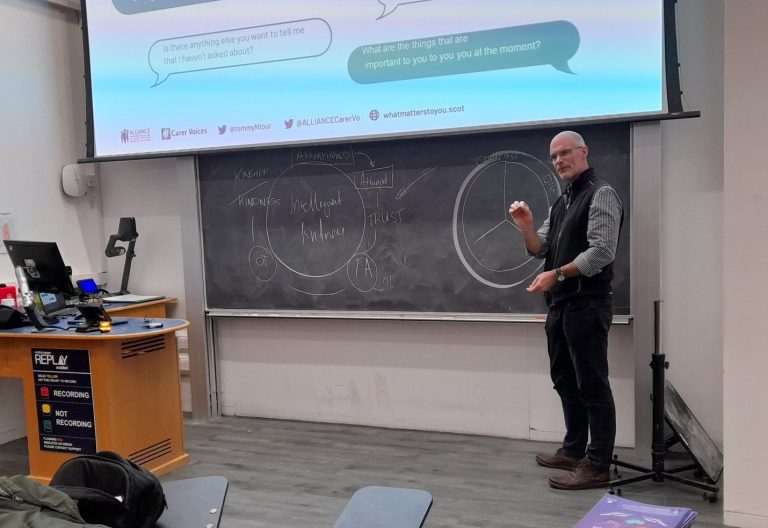
Shaun Maher, Strategic Advisor for Person Centred Care and Improvement at Scottish Government, discusses the concept of Intelligent Kindness
This is an excerpt from the latest Carer Voices publication ‘Effecting Change’, evidencing culture change in compassionate care across Scotland.
“Be kind” is a refrain we hear often these days, whether at work, on social media or in other settings. But what does it mean to be kind? In its most basic form kindness is a feeling of connection, shared existence and mutuality that results in compassionate supportive human relationships and interactions. The term “kindness” has its origin in the old English word “kin” used to describe the close family connections that form us and usually support us through life. Kindness in its broadest sense, reminds us that we are all part of one big family by merit of our shared humanity – part of an interconnected, interdependent whole, whether we realise it or not. We all have something to gain from kindness and we all lose when it is absent.
Whilst on one level we might feel sad that we need to be reminded to “be kind” it is good to think about what kindness is and to remember that if we neglect to nurture the conditions that create and support it, we can begin to lose sight of the very essence of what it is to be a human-being. Perhaps one of the reasons we need to ask people to be kind is that we have taken our eye off the ball and inadvertently squeezed the opportunity and time for careful, compassionate human interactions, even in health and care services. The sheer complexity and busyness of our modern health and care system, the industrialisation of processes and the way we manage them, has perhaps skewed organisational cultures to focus more on processes and data with the result that people and the things that matter most are sometimes overlooked.
Whilst we obviously need to make sure we manage our resources prudently and ensure things are working as they should, this should not cloud our core purpose – to help people live life well and achieve the outcomes that matter to them. Focussing intentionally and carefully on the things that really matter is the deeper meaning and purpose of our work. Ensuring we have opportunities and time to do this carefully and compassionately is intelligent kindness. Intelligent kindness can have a transformative effect on organisational culture and performance resulting in higher quality services and more efficient use of resources. Kindness by design, is creating a system that prioritises opportunities and time to focus carefully on listening and then working with people to help them achieve the outcomes that matter to them. This intelligent kindness not only supports better outcomes and better use of resources, but it also energises staff, enabling them to connect meaningfully with those they support or care for.
The case studies in this report highlight how the work of Carer Voices has helped organisations to kick-start or sustain their focus on the careful, compassionate interactions that underpin a culture of kindness. This helpful report shares first-hand experiences from organisations who are working purposefully to create opportunities for these meaningful human interactions. This work is not easy and there are challenges as we navigate this path, but there is nothing more important, and as the case studies show, it can be done and it really does make a difference.
End of document.
End of page.
You may also like:
Dr Anthony McMahon reflects on the importance of the Community Links Worker within his GP surgery - and why it makes all the difference.
Continue readingAs part of our 20 year anniversary, the Integration Team highlight the importance of our Connected Communities series.
Continue readingTo mark ‘What matters to you?’ Day, The ALLIANCE's Barbara Flynn considers the impact of Tommy Whitelaw’s talks for nurses and midwives.
Continue readingThe ALLIANCE’s Humans of Scotland project works to challenge stigma.
Continue readingIn her latest TFN column, our Chief Officer Sara Redmond reflects on post election feelings and Scotland’s future.
Continue readingALLIANCE Chief Officer, Sara Redmond, reflects on our Annual Conference 2026 and how we're turning hope into action.
Continue readingALLIANCE member, Catherine, shares the importance of initiatives like 'What Matters To You?' Day in promoting person centred care.
Continue readingLearn about how the ALLIANCE has championed joined-up, person centred care.
Continue readingDementia Action Week highlighted some great resources and support for people living with dementia and their family, friends, and carers.
Continue readingSteven Mair gives us an insight into his role as a gamer at the Glasgow Children’s Hospital Charity.
Continue readingSince 2009, ALISS has helped people find local health and wellbeing support. Any group, big or small, can add their information.
Continue readingThe new Scottish Government must turn promises into action to improve hospice and palliative care
Continue readingTogether, we can create lasting change for everyone living with Crohn’s or Colitis.
Continue readingFind out more about these digital self management tools and how to get in touch to arrange an information session.
Continue readingOur Chief Officer Sara Redmond addresses recent commentary on the relationship between Government and the Third Sector.
Continue readingCornell explores how we can build an environmental human rights-based culture
Continue readingLouise Coupland, Digital Health and Social Care Programme Manager shares her opinions on the national roll out of MyCare.scot.
Continue readingChris Mackie, Director of Digital, looks back at how ALISS has developed, grown, and innovated over time.
Continue readingCrohn’s and Colitis care in Scotland is at a pivotal moment. Urgent action is needed to tackle delays and poor access to vital services
Continue readingThe ALLIANCE’s Lewis Shaw reflects on the importance of rehabilitation support.
Continue readingIsabella Goldie of Deafblind Scotland reflects on the value of partnership work.
Continue readingFind out more about the inaugural Power of Attorney Day taking place on 22 April 2026.
Continue readingDr Hannah Tweed reflects on 20 years of the Scottish Sensory Hub, the important work they do and why it matters.
Continue readingAs part of our 20 year anniversary, Kerry shares her reflections on how far the ALLIANCE has come, our achievements, and our impact.
Continue readingIn her latest TFN column, our Chief Officer Sara Redmond reflects on 20 years since Scotland moved to put children at the centre of policy.
Continue reading