
Courageous Leadership in Front-Line Support Work
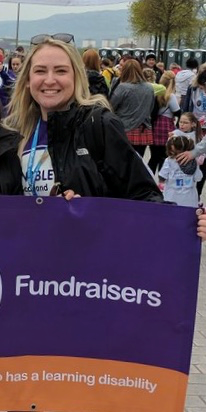
- Written by: Hayleigh Furlong — ENABLE Scotland — Personal Assistant, Lanarkshire Services
- Published: 27th February 2018

Hayleigh shares examples of courageous leadership from her own experience of front-line support work.
Hayleigh Furlong is a front-line support worker with ENABLE Scotland, providing 24-hour support in an adult learning disability service. Hayleigh attended the Academy’s ‘Unleashing Courageous Leadership at Every Age’ Event and shares her thoughts on this topic.
For me, personally, Courageous Leadership is about creativity and innovation. Good leaders in Social Care think outside of the box, they find new and creative ways to support individuals to plan their own service. Since the development of the Self-Directed Support Act in 2013, person centred planning has become the most important aspect of service design, so I believe that a courageous leader in Social Care is one who takes risks in finding new ways to design services.
At a management level, a courageous leader is someone who recognises the potential of their front-line staff. Front-line staff are the drivers of person centred planning and we know the people we support better than anyone out-with their families. Front-line staff hold the tools for encouraging people to participate in their own support planning, so managers should put faith in their staff and empower them to support individuals to design their own services.
I support an individual with limited verbal communication and at first she struggled to tell us what she wanted to do with her support hours, as she simply could not find the words to do so. I think of myself as quite a creative person and, having been trained on the Talking Mats communication resource, I tried this with the individual to give her the opportunity to show me what activities she wanted to try. This was successful and provided us with a base for planning her weekly support. Over time, she embraced the Talking Mats resource and now uses it to tell us how she is feeling and even used to it to show us that she knows how to sign and would prefer not to use her voice to communicate.
By taking a risk and introducing this individual to a new method of communication I have provided her with the opportunity to drive her own support planning in a new and creative way. Other members of staff in the organisation have now been trained up on the Talking Mats resource because of the success it was has had with this particular individual, so courageous leadership is not only about creativity and innovation, it is also about influencing and collaboration, as a courageous leader uses their work to influence and inspire others.
However, as front-line support workers, we also have the potential to influence others in bringing about wider change.
As front-line members of staff in social care we are the little guys – but it is often the little guys who can make the most noise. We are the ones who live the every day experience of providing direct support, so we are the ones who are the drivers of change. By not being afraid to speak out, front-line staff can influence change – from changing an outcome for the person they support to influencing new legislation at a national level.
In October 2017 it was announced that front-line staff would be paid the living wage through the night when providing “sleepover” support. I am proud that I was involved in this change. Fairer pay is something that Enable Scotland are very passionate about. Enable recognise that retaining high quality, dedicated staff in social care can only be achieved through fairer pay, and having previously done some writing on this issue myself I was delighted to assist Enable’s Chief Executive in campaigning for fairer pay for staff providing overnight support.
I live the experience of overnight support and I know that during overnight support staff are awake most of the night, and we do this for a very low rate of pay. Although the subject of fairer pay for overnight support is a controversial one in the sector, I took the risk of speaking to a journalist to provide a first-hand account of the reality of overnight support. I am delighted to say the risk paid off.
My experience shows that front-line support workers can be heard. So ultimately, courageous leaders are not afraid to take risks in influencing others to bring about change – even in an environment where there is opposition to what they have to say.
All opinions expressed in this piece are that of the author. If you would like to hear more about the Health and Social Care Academy’a Courageous Leadership series and sign up for the next event on 24 April please contact academy@alliance-scotland.org.uk for more details.
End of page.
You may also like:
Sheila Duffy, Chief Executive of ASH Scotland, is appealing for support for proposals to restrict tobacco, vapes and nicotine products.
Continue readingBilly McClean reflects on why SCIC26 offers a vital opportunity to learn together, share what works, and shape the future of integrated care
Continue readingTo mark the ALLIANCE's 20 year anniversary Paul Okroj reflects on the importance of supported self management.
Continue readingTo mark Scottish Learning Disability Week (7 - 13 September), Bruce Adamson reflects on this year's call to action.
Continue readingIn her latest TFN column, our Chief Officer Sara Redmond reflects on the current state of social care in Scotland.
Continue readingKicking off September for the ALLIANCE's 20 year anniversary, Grace reflects on the Self Management Programme
Continue readingSara Redmond, ALLIANCE Chief Officer, on the priorities for 2026's Programme for Government.
Continue readingSandra Auld reflects on the ALLIANCE's people focused impact, collaboration, lived experience, campaigns and lasting change in Scotland.
Continue readingMark shares his experience with gambling harms, and how this intersected with the launch of the ALLIANCE's ScotRGH programme in 2020.
Continue readingProfessor Anna Glasier celebrates 20 years of the ALLIANCE and it's vital role in shaping the Women's Health Plan for Scotland.
Continue readingSara Redmond, ALLIANCE Chief Officer, on the challenges faced by community-led health organisations in delivering prevention.
Continue readingAnnie shares her experience of youth politics, and how SAFE has helped her make connections and makes sense of the world of politics.
Continue readingChloe Craig reflects on how we have helped connect Scotland’s lived experience voice to conversations happening beyond our borders.
Continue readingDr Irene Oldfather reflects on two decades of growth, collaboration, and person centred impact across Scotland and beyond.
Continue readingDisabled people are some of those who suffer most in crises but are ignored in planning. Our 6-step model builds justice throughout.
Continue readingMaisie Peebles shares her experience working with Aberdeenshire Public Health Team on a ‘digital conversations’ project.
Continue readingSara Redmond, ALLIANCE Chief Officer, on why the Scottish Government and parties must seize the opportunity for change.
Continue readingDirector of the Links programme, Roseann, discusses why we need to focus on person centred care, and why the programme is central to this.
Continue readingReflections on the ALLIANCE Integration in Action: Inclusive Leadership event.
Continue readingWhat does The Scottish Report tell us about how we're supporting people with inflammatory mediated autoimmune conditions (IMIDs)?
Continue readingAvril McLean from Action from ME shares new resources designed to support professionals understand the impact of ME on people's lives.
Continue readingMandy Wright from Home Energy Scotland shares how partnerships positively impact their work.
Continue readingToo many young people are falling through the mental health support gap. How do we fix the "Missing Middle"?
Continue readingJoe McCready from Carers UK shares how important their annual survey is, and why it is invaluable for unpaid carers to have their say.
Continue readingColette reflects on the last 12 years of the Community Links Worker programme, as well as her own experience of being a CLW.
Continue reading