
20 Years of Inclusion and Impact: The Growth of The Scottish Sensory Hub
- Area of Work: Scottish Sensory Hub
- Type: News Item
- Published: 14th April 2026
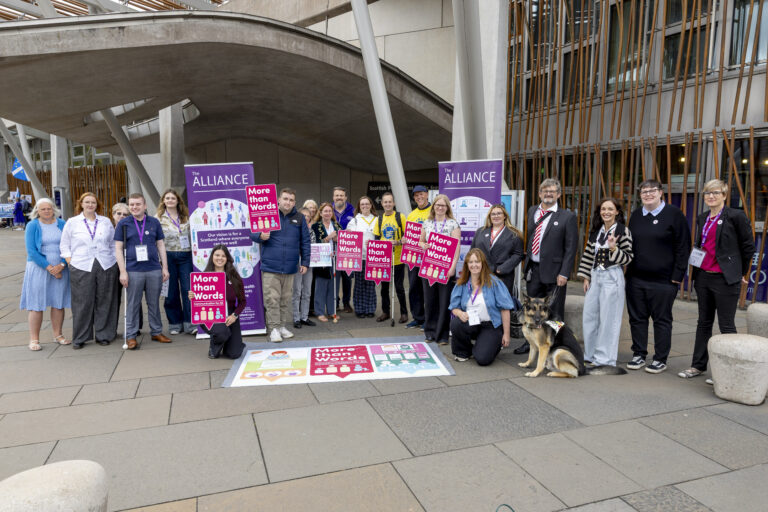
As part of our 20 year anniversary, we celebrate the Scottish Sensory Hub, the important work they do, and why it matters.
Most of us will experience Deafness, Deafblindness or Visual Impairment – if not now, then in older age. That’s why the work of the Scottish Sensory Hub is so important.
Who are we?
The Health and Social Care Alliance Scotland (ALLIANCE) Scottish Sensory Hub brings together expertise spanning disability research, health and social care, and community engagement work. The team includes Hannah, Amy, Lewis and Ellie.
In terms of our programme’s history, that’s a bit more complicated.
We formed in 2021, following the merger of DeafScotland and the Scottish Council on Visual Impairment – and at the same time, became an ALLIANCE programme. Since then, we have become Scotland’s only national forum for people who are Deaf, Deafblind, or who have a Visual Impairment. We deliver cross-sensory research, policy, and campaign work, in partnership with members and supporters from across the sensory sector.
What do we do?
Our work involves juggling a lot of plates to address the persistent barriers that people who are Deaf, Deafblind, or who have Visual Impairments face every day in Scotland. If we look back over the timeline of our work over the last twenty years, members of the Scottish Sensory Hub programme have been actively involved in:
- The British Sign Language (Scotland) Act 2015, and the two round of national and local plans that stemmed from that legislation.
- The See Hear Strategy (2014) and over a decade of subsequent work to support sensory work across Scotland, at local and national levels.
- Campaigning for the pilot and retention of the Contact Scotland BSL service (2015, 2016, and 2025).
- The Independent Review of Audiology Services in Scotland (2023), and subsequent activity to improve audiology services.
- Campaign work on a definition of Deafblindness for Scotland (accepted by the Scottish Parliament in 2025).
- The development and launch of vision rehabilitation courses in Scotland, to enable a sustainable workforce of Vision Rehabilitation Specialists and Assistants (2025).
- Campaign work to improve communication for all – from involvement in the development of the Scottish Government’s Principles of Inclusive Communication (2011), to our most recent campaign, More than Words: Communication for All (2025).
Why does this matter?
Deafness, Deafblindness or Visual Impairment will be experienced by most of us as some point in our life. Right now, 1 in 3 people in Scotland are Deaf – yet there is little in the way of coordinated planning to enable everyone to have equal access to public life.
Looking to the future, it’s easy to see both the breadth of challenge ahead, but also the potential for change. In the last year alone, the Scottish Sensory Hub team have seen significant changes – from the renewed commitment to Contact Scotland BSL by the Scottish Government, to the formal acceptance of a definition of Deafblindness for Scotland, with progress on developing care pathways.
Looking through the Scottish Sensory Hub archives in preparation for writing this, it’s clear that collaboration has been at the forefront of work in this area since the outset – along with a persistent drive to challenge injustice. Minutes from the 1890s through the 1960s and into the twenty-first century show the drive for change. Equally clear is that the most effective campaign work stemmed from partnership working – when people and groups across Scotland work together for change.
End of page.
You may also like:
Have your say on the role of Vision Rehabilitation Assistants.
Continue readingSocial support group for adults with any level of Deafness or tinnitus.
Continue readingComplete this consultation if you access optometry services, support people to access eye care services, or are an eye care professional.
Continue readingFirst FIFA tournament to have sign language interpretation broadcasts for all matches.
Continue readingNew guidance supports Audiology services to design and develop clinical peer review schemes to support quality assurance.
Continue readingRegister for this paid Advisory Panel opportunity
Continue readingTake a short survey to share your experiences
Continue readingLearn about this new way NDCS are supporting families.
Continue readingShare your experiences of accessing and using NHS Lothian services by survey or focus group.
Continue readingNew appointments for Màiri McAllan, Alison Thewliss, Maree Todd and Simita Kumar.
Continue readingSign up to participate in this co-design study
Continue readingImproved voting accessibility for people with Visual Impairment
Continue readingReport calls on the UK Government to ensure Access to Work is fully accessible .
Continue readingHelp shape the new guidelines
Continue readingHelp future technology become more accessible
Continue readingThe ALLIANCE has produced a report for the Scottish Parliament's Cross-party Group on Deafness.
Continue readingTake part in participant-led rail journey research
Continue readingTake part in this survey if you have a long term condition, are Deaf, Deafblind or have a Visual Impairment
Continue readingLearn more about the Parkrun BSL glossary and YouTube video series
Continue readingFind Lipreading classes local to you
Continue readingPaid internship opportunity for school leavers with Visual Impairment
Continue readingAn examination of the role of social workers in alleviating stigma experienced by members of the Deaf community in Ireland and the UK
Continue readingThis study is for young people aged 12–16 years living in Scotland, who are Blind or have Severe Sight Impairment
Continue readingOnline toolkit makes it easier for people to communicate with public services.
Continue readingThe Scottish Diabetic eye screening programme checks for diabetic retinopathy - when diabetes causes Visual Impairment
Continue reading